

Simulated Companionship: India’s intimacy complexity
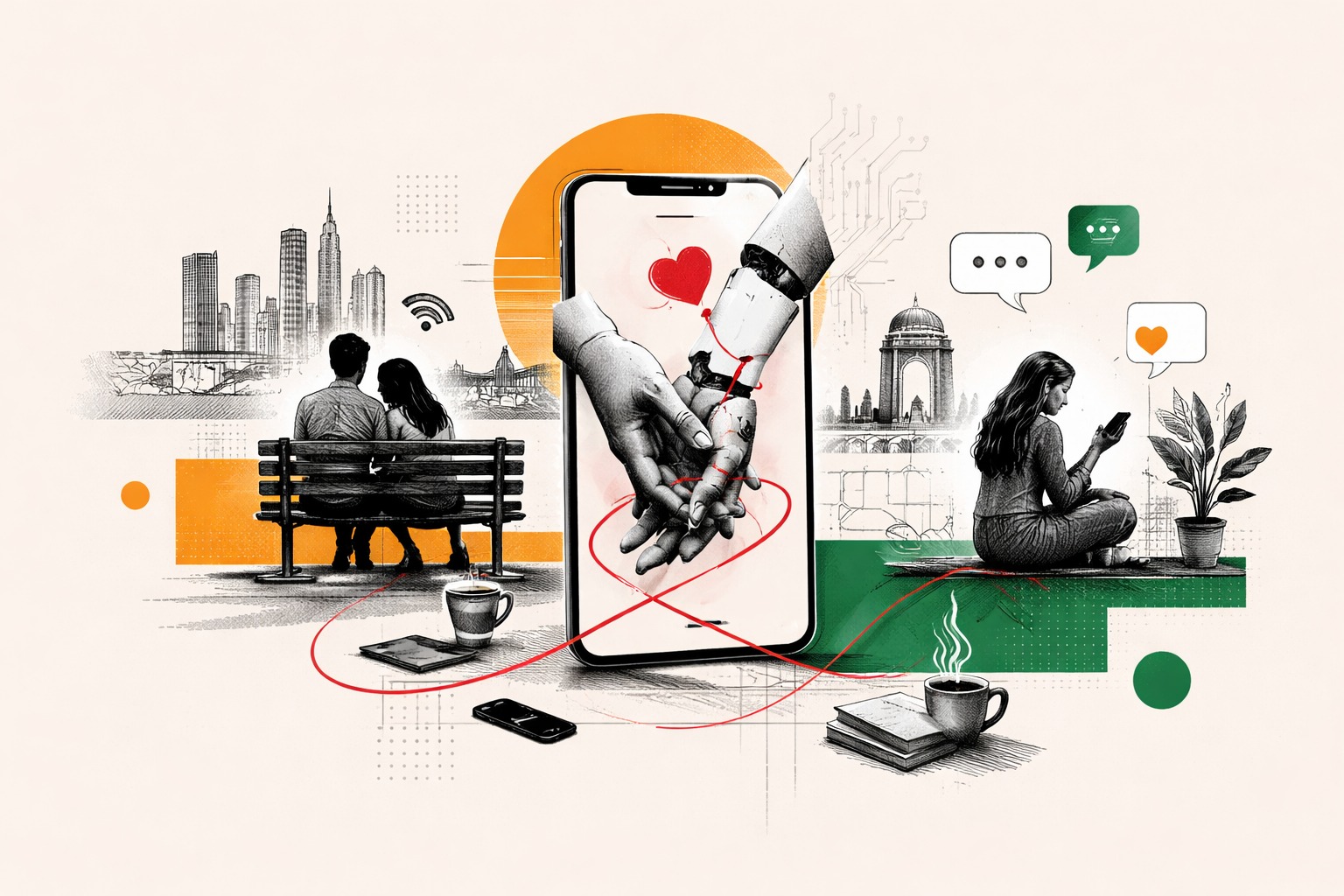
For most of human history, intimacy has been inseparable from relationships between people. Love, desire, and companionship have unfolded through interactions that are often unpredictable, emotionally demanding, and shaped by mutual negotiation. Over the past few decades, however, digital technologies have gradually begun to reshape how intimacy is experienced. Online pornography altered sexual expectations, social media blurred the boundaries between public and private relationships, and dating applications expanded the pool of potential partners while simultaneously introducing a logic of replaceability into romantic life.
Artificial intelligence represents a further shift. Rather than merely facilitating interactions between people, AI companions, from conversational chatbots to customizable virtual partners, are increasingly designed to simulate companionship itself. These systems can sustain extended conversations, respond with emotional reassurance, and engage in erotic roleplay. In doing so, they move technology from the margins of intimate life toward its centre, offering experiences that resemble companionship rather than simply mediating it.
Evidence from India suggests that such interactions are already entering everyday intimate life. A 2026 survey conducted by the extramarital dating platform Gleeden in collaboration with Ipsos, based on respondents across Tier-1 and Tier-2 Indian cities, found that 49% of respondents reported having chosen sexual interaction with an AI system rather than physical intimacy with their partner at least once (Gleeden & Ipsos, 2026). At the same time, 65% of respondents considered erotic engagement with AI to be a form of cheating, reflecting a tension between emerging technological practices and existing norms surrounding fidelity.
More broadly, the survey suggests that AI is beginning to occupy both emotional and sexual spaces within relationships. A majority of respondents reported experimenting with AI-generated romantic or sexual interactions, whether through virtual companions, erotic content, or intimate conversations. While such findings should be interpreted cautiously corporate surveys often capture experimentation as much as sustained behaviour, they nevertheless indicate that AI-mediated intimacy is becoming part of the broader landscape of relationships.
These developments resonate with emerging research on human–AI relationships. Studies of conversational AI platforms suggest that users can develop emotional attachments to digital agents, sometimes experiencing feelings similar to those found in interpersonal relationships (De Freitas et al., 2024). What distinguishes AI intimacy, however, is not simply the presence of technology but the structure of the relationship it offers. AI companions are designed to be consistently attentive, emotionally validating, and adaptable to individual preferences. They rarely disagree, withdraw emotionally, or require compromise.
Human relationships, by contrast, are shaped by negotiation and emotional reciprocity. Partners misunderstand each other, demand attention, and carry needs of their own. If individuals become accustomed to forms of intimacy that are consistently responsive and frictionless, the ordinary complexity of human relationships may begin to feel unusually demanding. In this sense, AI companions may not replace relationships outright, but they may gradually reshape expectations about what intimacy should feel like.
The implications extend beyond individual behaviour. Many societies are already experiencing declining marriage rates and falling fertility levels, influenced by economic pressures, changing gender roles, and evolving attitudes toward family formation. If emotional companionship and sexual fulfilment can increasingly be experienced through artificial partners, some individuals may feel less urgency to pursue relationships that involve long-term commitment, negotiation, and shared responsibilities.
In India, these technological shifts intersect with ongoing discussions around adolescent well-being and relationship education. Initiatives such as the Adolescent Education Programme (AEP) were introduced to promote life skills, health awareness, and responsible decision-making among young people (Ministry of Human Resource Development & NACO, 2007). Yet conversations about relationships, emotional intimacy, and the evolving digital environments in which young people encounter sexuality remain uneven across educational settings. As technologies increasingly shape how individuals learn about intimacy, through social media, online content, and AI-mediated interactions, the need for more comprehensive and context-sensitive approaches to sexuality and relationship education becomes more evident.
Such efforts need not centre on explicit sexual instruction alone. Rather, they can focus on helping young people understand emotional wellbeing, consent, digital relationships, and the complexities of intimacy in an increasingly mediated world. Without such conversations, technological change risks shaping intimate life in ways that remain largely outside public understanding.
The emergence of AI companions does not necessarily signal the disappearance of human relationships. What it does reveal, however, is a gradual shift in how intimacy itself is organised. If companionship, emotional reassurance, and sexual interaction can increasingly be simulated through responsive technologies, the expectations people bring into relationships may begin to change.
Seen in this light, the challenge before society is not simply technological but social. The question is not whether AI can simulate intimacy; evidence increasingly suggests that it can, but how societies choose to understand and respond to this transformation. Addressing that question will require not only technological awareness, but also educational and cultural conversations about what intimacy, relationships, and emotional connection should mean in an increasingly digital age.
References
- • De Freitas, J., Castelo, N., Uguralp, Z., & Uguralp, A. (2024). Identity continuity and emotional attachment in human–AI relationships.
- • Gleeden & Ipsos. (2026). Survey on artificial intelligence, dating, and intimacy in India.
- • India Today. (2026). Survey on AI intimacy and behavioural patterns in India.
- • Ipsos. (2026). Love life satisfaction index: Global report.
- • Ministry of Human Resource Development & National AIDS Control Organisation (NACO). (2007). Adolescent Education Programme (AEP): Life skills and sexuality education for adolescents in India.