

When the War Came to the Gulf
Nobody expected a full war to break out in West Asia in February 2026. But on 28 February, US and Israeli aircraft struck Iranian leadership, command posts and missile factories in a single wave. Iran’s response was immediate and instructive. Rather than send its ageing air force into almost certain destruction, Tehran unleashed what it had been building for years: thousands of cheap one-way attack drones, ballistic missiles and cruise missiles aimed at everything from Israeli cities to American air bases in Qatar, Kuwait and Iraq. While doing my PhD on AI in defence and security policy at the School of International Studies in JNU, one of the patterns I kept encountering in the literature was this: states that invest early in asymmetric drone and missile capabilities tend to use them not as a last resort but as a first response, precisely because they are cheap, deniable and psychologically disorienting. The 2026 Iran campaign is a textbook confirmation of that finding. While interacting with a noted Indian defence analyst for my research, he put the cost calculus bluntly: Iran uses a drone costing about 30,000 dollars to force defenders to fire an interceptor missile costing millions. The UAE detected 1,422 Iranian drones in a matter of days. It shot down 1,342 of them. But 80 still got through, killing civilians from several countries, including South Asia. Even more alarming, a sophisticated American early warning radar protected by multiple air defence layers was reportedly damaged by a single drone. If that can happen in the Gulf with US technology, India needs to think very hard about what it would face from China and Pakistan with the same playbook.
India’s Bet on a Ten-Year Mission
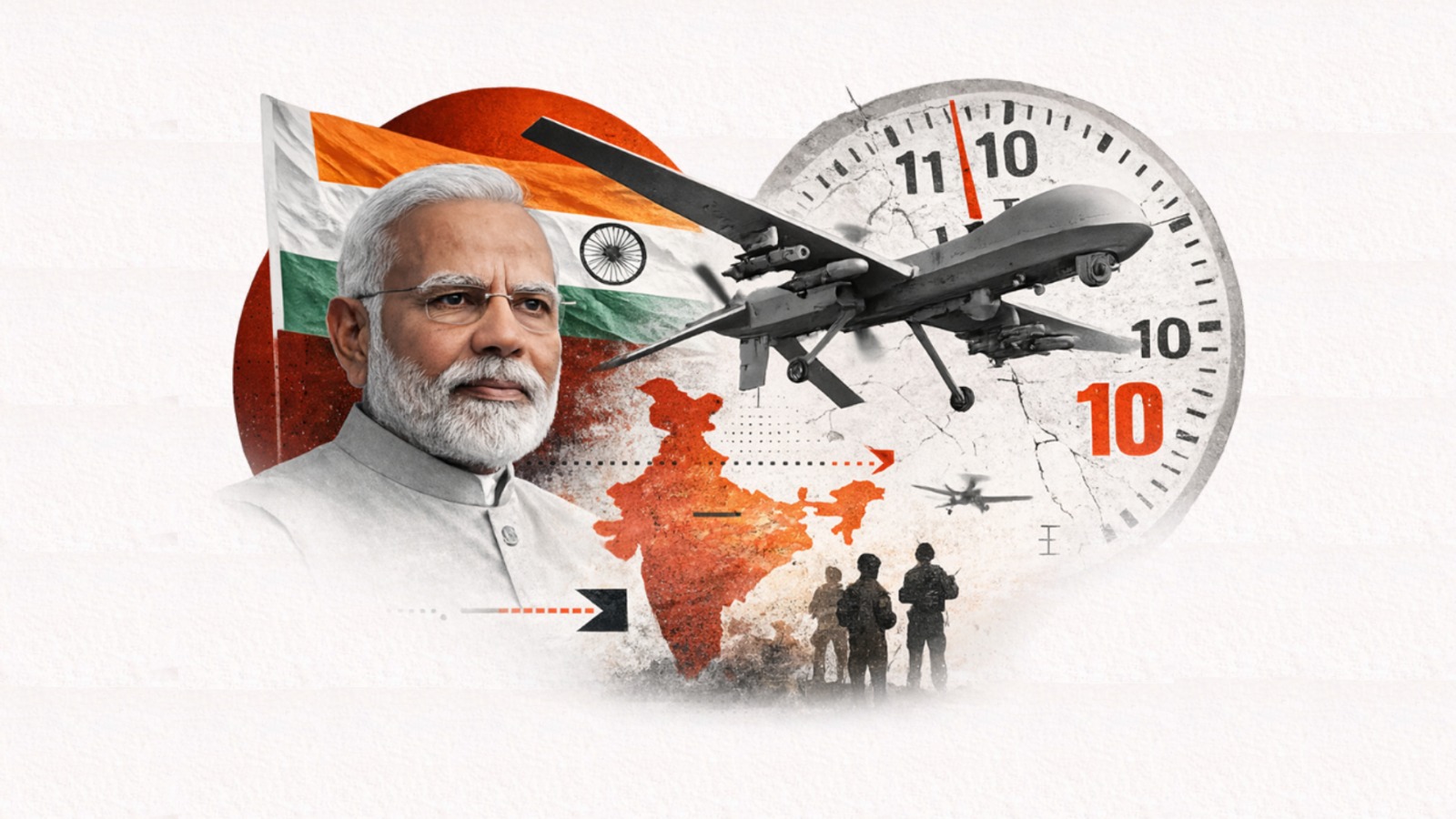
India’s response to this changing world is Mission Sudarshan Chakra. Announced in August 2025, it is India’s most comprehensive air defence vision ever put to paper. The plan is to build by 2035 a nationwide, multi-layered system integrating thousands of radars, satellites, AI-enabled sensors and directed-energy weapons into one seamless network capable of protecting everything from the Prime Minister’s office to a district hospital in Assam. A few days back, I appeared on a panel on NDTV Profit’s The Big Question, where the host Vikram Oza asked me directly about the Sudarshan Chakra. I said on national television what I genuinely believe: the vision is right, but India must move on this far more quickly than the current timeline suggests. The building blocks are already in place or in the pipeline. S-400 batteries provide long-range cover. Akash and MRSAM handle medium-range threats. The indigenous BMD programme covers ballistic missiles with two-tier endo- and exo-atmospheric interception. DRDO’s Project Kusha will add a domestic S-400 class capability. And the AI-enabled IACCS already ties together air defence across services in near real time. Lessons from Operation Sindoor in 2025, where India successfully used this network against Pakistani drone and missile attacks, have been fed directly into Sudarshan Chakra planning. This is a genuinely serious national programme. The single biggest risk is not the technology. It is the calendar.
The Uncomfortable Math of Time and Threat
Here is the problem that no one in South Block likes to say out loud. India’s BMD programme was first declared complete and ready for limited deployment to protect Delhi and Mumbai back in 2017 to 2018, but full operational deployment is still pending. That is nearly a decade of delay on just one piece of the Sudarshan Chakra jigsaw. As a content creator who regularly produces content on defence, security and emerging technology, I have gone back through my own research archives across years of writing and videos and I keep finding the same pattern: India announces a landmark defence capability, the defence establishment generates genuine excitement around it, and then the deployment quietly slips by two, three, or sometimes five years with very little public accountability. The hypersonic interceptors needed for Phase 3, designed to counter China’s and eventually Pakistan’s hypersonic glide vehicles, are not expected to reach even the trial stage until the early 2030s. Yet China has been fielding hypersonic missiles for years, and analysts already warn of a Sino-Pak axis using high-altitude drone swarms to drain Indian interceptor stocks before sending in the heavy weapons. Operation Sindoor showed that Pakistan can launch 300 to 400 drones in a single campaign. Iran’s 2026 campaign showed that even the best-protected radars in the world can be damaged by simple drones when the volume is high enough. If Sudarshan Chakra follows historical timelines, it may arrive at full strength just as the threat has evolved to something entirely different. That is the uncomfortable math India must confront honestly.
Changing the Pace Without Changing the Plan
The good news is that the solution does not require scrapping Sudarshan Chakra and starting over. It requires disciplined acceleration and smarter sequencing. As a subject matter expert at CENJOWS, India’s tri-services think tank under the Ministry of Defence, I once asked a decorated military veteran during an institutional event what in his view was the single biggest structural problem in Indian defence procurement. Without hesitating, he said: we are very good at building the right thing and very slow at fielding it. That answer stays with me every time I read a Sudarshan Chakra progress update. Phase 1 coverage, protecting Delhi, Mumbai, major nuclear sites, the most critical air bases and naval ports, should be treated as a non-negotiable 2028 target, not a rolling aspiration. Every component, radar, interceptor and command link, for those 8 to 10 zones should have a fixed delivery date with accountability attached. Along India’s western and northern borders, dense counter-drone grids combining guns, short-range missiles, jammers and directed energy weapons like the DRDO Adani vehicle-mounted system should be deployed at scale, not in small demonstration lots. This is the inner layer that stops the cheap drone before it finds the expensive radar. Simultaneously, the AD-AH and AD-AM hypersonic interceptor programme should be given the same national priority as nuclear or space programmes, with dedicated funding and timelines. Iran’s 2026 campaign just wrote the threat scenario document for free.
What India Gains by Acting Early
Speed has a strategic payoff that is very specific in this context. I still remember being in Russia during my fellowship there, visiting research institutions and interacting with their strategic community. What struck me was not the size of their military or the sophistication of their weapons. It was how seriously Russian planners treated the idea of timeline compression in air defence. They had a phrase that came up repeatedly in conversations: the shield must be ready before the sword is sharpened, not after. India is in exactly that moment right now. Every year that India accelerates its shield beyond the current timeline is a year in which the deterrence calculation shifts. Pakistan and China are not planning to attack India in 2025 or 2026 in isolation. They are planning in response to what they think India can and cannot stop. A credible early capability, even if not the full 2035 system, changes what an adversary is willing to risk. Beyond deterrence, the economic stakes are large. India’s economy depends on a handful of refineries, ports, financial nodes and data centres that would be obvious targets in any serious conflict. Protecting them by 2030 rather than 2035 is not just a defence question. It is a growth question. The domestic industry benefit is also significant, as every accelerated procurement of indigenous systems from DRDO and private firms creates supply chains that cannot be sanctioned or disrupted by foreign suppliers. West Asia in 2026 is telling us clearly that the cost of under-investing in air defence comes due suddenly and violently. The ten-year plan is right. The ten-year pace is the problem.