

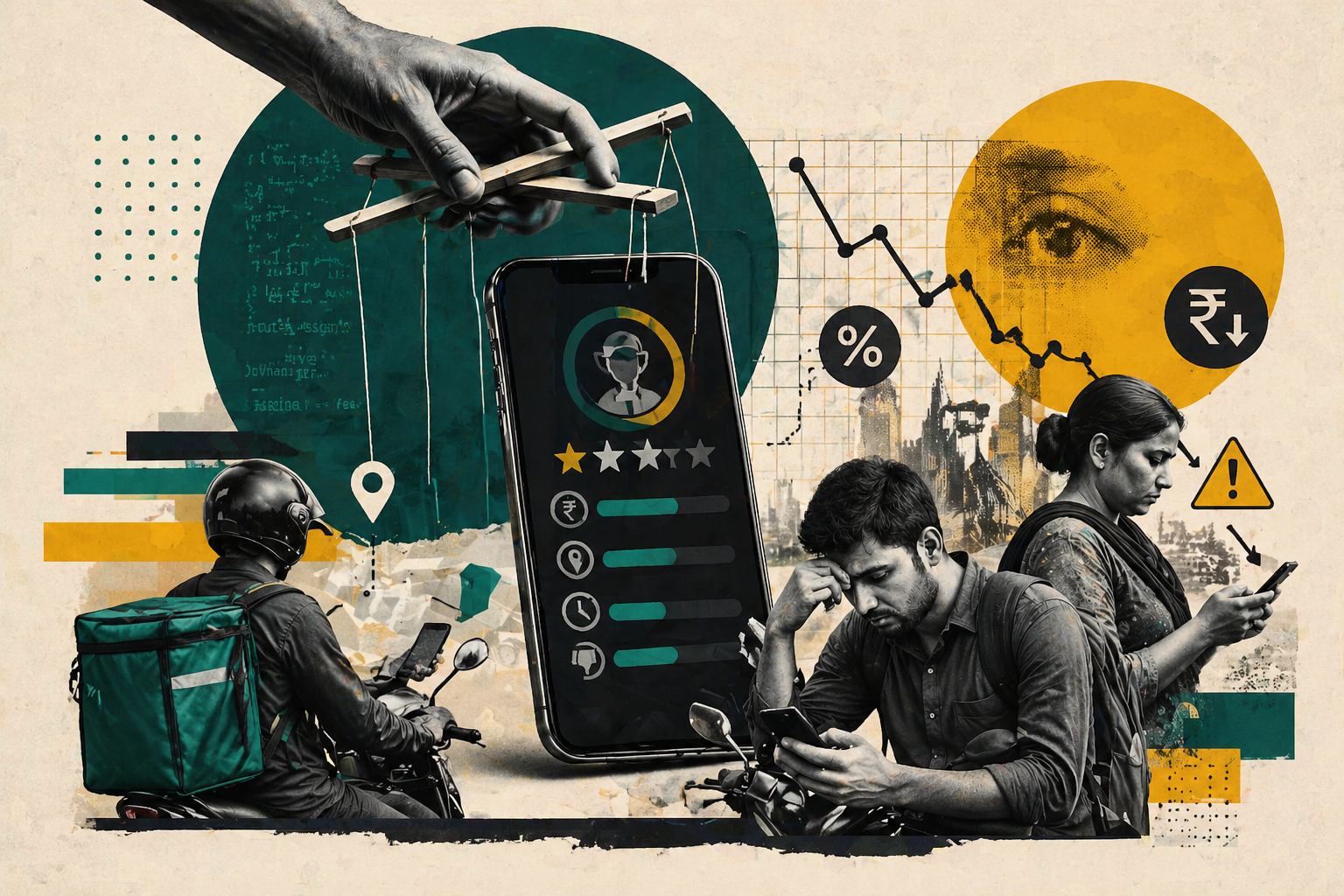
Earlier this year, Eternal-owned Blinkit removed the ‘10-minute delivery’ claim from its platform, following discussions with the Union Ministry of Labour, and the strike staged by platform workers on New Year’s Eve in 2025. Looked at closely, the 10-minute delivery model exposes the gamification of gig work. A game-like timer on the workers’ screens, one task after another, directly shapes their earnings while placing their safety and wellbeing at risk.
Imagine playing a game on your phone: 8-ball pool perhaps, built around streaks, timed moves, spin wheels, and lucky shots. Sometimes, you win, and other times, you lose, often unpredictably. The objective of the game is to get you hooked by rewarding speed and consistent engagement. As an experienced player, you may even know that the system is rigged.
This is what platform work can feel like for millions of workers in India’s rapidly expanding gig economy, as they navigate algorithmic systems that manage work through opaque scoring mechanisms, fluctuating incentives, and automated penalties, for instance, the failure to meet an unrealistic delivery timeline. Platform work increasingly resembles a high-stakes game, except what is on the line is not virtual points, but earnings and livelihoods.
When Work Becomes a Game
Gamification, the use of game-like elements such as points, badges, leaderboards, and rewards in non-game contexts, has long been deployed in workplaces. From performance bonuses to employee-of-the-month schemes, such tools have historically been justified as ways to boost motivation and productivity. But in the platform economy, where work is almost entirely digitally mediated, gamification takes on a more coercive form.
Unlike traditional workplaces, platform workers are classified as independent contractors, not employees. This places them outside the ambit of labour protections, social security, and formal grievance redressal mechanisms. Within this regulatory vacuum, platforms exercise control through algorithmic management: systems that allocate work, determine pay, evaluate performance, and impose sanctions with minimal human oversight.
This is not a far-fetched comparison or a bombastic metaphor. A September 2025 report by the Centre for Responsible Artificial Intelligence (CeRAI) at IIT Madras documents how these systems produce what many workers experience as ‘algorithmic cruelty’. The report notes patterns such as order allocation slowing down precisely when workers approach incentive thresholds, or newly onboarded workers receiving more orders than experienced ones. These practices closely resemble the logic of mobile games that shower beginners with rewards to hook them in, only to steadily increase difficulty once dependence sets in.
The cruelty is not limited to exceptions. It is embedded in the broader architecture of platform work: continuous monitoring, real-time performance scoring, automated decision-making, and near-total opacity about how algorithms function. Grievances are routed to chatbots rather than human representatives; penalties are imposed without meaningful redressal; and appeals, if they exist at all, are slow and ineffective.
This design creates a psychological environment of constant uncertainty. Workers are nudged to accept more tasks and work faster. The gamified interface masks what is, in effect, an intense system of unethical labour extraction. In the platform economy, this dynamic is particularly stark. Virtual badges and leaderboard positions cannot compensate for the absence of stable income and social protection, especially when in India, gig work is not necessarily supplemental or part-time. For many workers, over 60% as per a Primus Partners report, it is the only available source of income, leaving little room for the choice or flexibility that platforms claim to offer.
Yet gamification itself is not inherently exploitative. The question is not whether game-like design should exist, but how, and for whom, it is deployed.
Reclaiming Design for Workers
The CeRAI report points towards alternative possibilities. One of its recommendations is for platforms to embed micro-learning modules into worker apps, acknowledging how skill gaps, time constraints, and lack of opportunity trap workers in low-skill, low-mobility roles in the gig economy. Used thoughtfully, gamification could reward skill development, learning milestones, or safety compliance, rather than the speed with which a delivery is completed.
This would require platforms to actively embed inclusive design principles into their development processes. Such approaches emphasize involving diverse stakeholders throughout the entire lifecycle of application development, with consistent consultations. Importantly, these stakeholders extend beyond customers who use the app to book rides or order groceries. They also include drivers and delivery workers, who are equally critical users of the platform.
More broadly, there are already interesting examples of the principles of gamification being used against exploitative practices. The Fairwork project, coordinated by the Oxford Internet Institute and the WZB Berlin Social Science Center, evaluates and assigns scores to platform companies based on working conditions. By publicly rating platforms against fair work principles, it subjects companies themselves to reputational pressure.
In its 2024 India ratings, companies such as BigBasket, Swiggy, Urban Company, and Zomato scored six out of ten. Since 2022, however, no platform has scored a single point on fair representation of worker voices. This inversion of the scoring logic, examining the platform rather than the worker, offers a glimpse of how gamification, by design, can be used to advance accountability rather than exploitation.
Towards Humane Platforms
If India is serious about shaping the future of work, it must move beyond surface-level debates about tech-driven innovation and efficiency. The gamification of gig work reveals a deeper design problem: systems optimised for engagement and output, but largely indifferent to human costs.
Resisting this requires structural interventions. Platforms must be required to introduce human-in-the-loop grievance redressal mechanisms, ensuring that workers can meaningfully contest decisions made by algorithms. More fundamentally, participatory design approaches for these applications should be mandated, bringing workers into the process of shaping the digital platforms that govern their labour.
Without such changes, the gig economy will continue to resemble a rigged game, one where the rules shift without warning, the odds are stacked against workers, and quitting is often not a real option.