

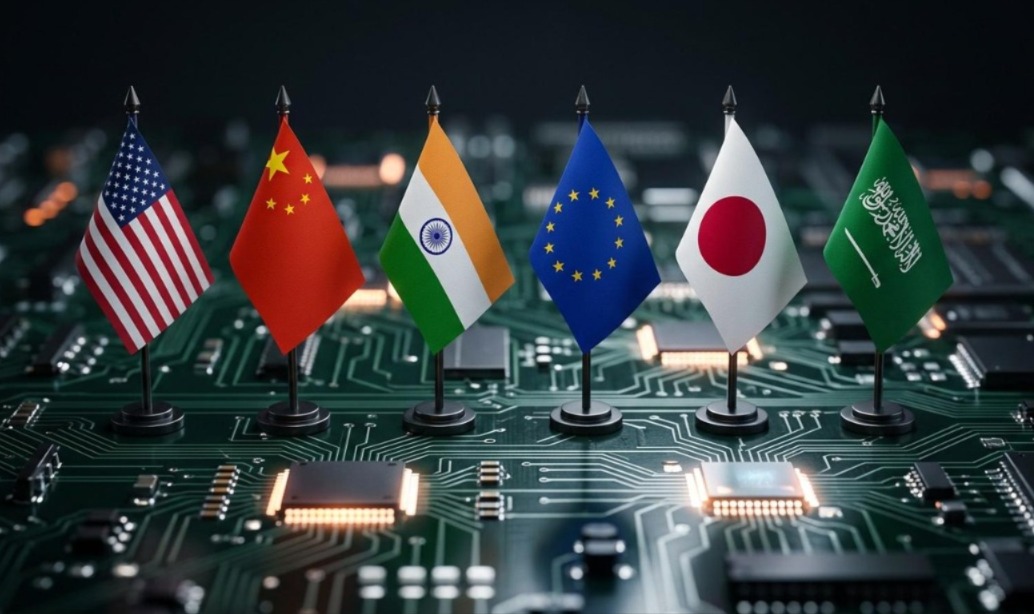
AI sovereignty now sits at the centre of international diplomacy, as it no longer confined to the domain of specialist debate. At Davos in January 2026 it is high on the agenda, at the AI Impact Summit in New Delhi the following month it is a central theme, and at the G7 meeting in Évian in June it lies behind the anxieties that shape the agenda. The governments from Brussels to New Delhi and to Riyadh, the states are treating control over compute, data and models as a precondition for economic competitiveness, national security and strategic autonomy. Yet, a quieter realisation is spreading alongside the ambition as the nation-states are coming to terms with the fact that full AI sovereignty is beyond the reach for most of them. A recent asset-level study of twelve countries and blocs finds full-stack sovereignty exceptionally rare, as Fortune reports that the United States and China control about 90 per cent of global computing power.
This article argues that the policy question is therefore not whether states should be sovereign or interdependent, but how they can manage interdependence so that it enlarges rather than erodes their capacity for autonomous choice. It first sets out a framework drawn from the study of asymmetrical and weaponised interdependence. It then examines the AI stack as a network of chokepoints, and closes with principles for managing interdependence, with particular attention to India.
Sovereignty, interdependence and power
Robert Keohane’s account of asymmetrical interdependence is the starting point. He argues that asymmetrical interdependence can be a source of power, a power which control over resources, or the potential to affect outcomes. He asserts that, the less dependent actor in a relationship often has a significant political resource, because changes in the relationship will be less costly to that actor than to its partners, as it is placed in an advantageous position deriving the capacity to act on it. These favourable asymmetries in interdependence will lead to similar patterns of control over outcomes. His work with Joseph Nye adds a useful distinction between sensitivity and vulnerability in which they emphasised the role of power in interdependence within these dimensions. Farrell and Newman carry this logic into the networked economy. They argue that the, global networks have a topography that produces enduring power imbalances, so states that host key nodes can gather information from the network, the panopticon effect, the chokepoint effect or deny adversaries access to it. AI intensifies both dynamics, because training and deploying advanced models runs through a small number of semiconductor, cloud and software hubs.
Against this background, AI sovereignty is best understood as capacity rather than ownership. For the purposes of this article, it means the ability of a state to make and sustain meaningful choices about how AI is developed, deployed and governed within its jurisdiction, even when some inputs come from abroad. Multilateral voices now point the same way. Cathy Li, who leads the World Economic Forum’s Centre for AI Excellence, argues for moving away from full national ownership towards “strategic interdependence”, and the Forum’s January 2026 paper with Bain & Company warns that sovereignty is increasingly conflated with infrastructure ownership.
The following three features make AI distinctive as a site of interdependence. First, its layers are tightly coupled, so a constraint on chips, power or software can leave capacity idle elsewhere in the stack. Second, switching costs are high, because models, tooling and talent become tuned to particular hardware and cloud environments. Third, the technology is dual-use, which gives exporting states a security rationale for controls and importing states a security rationale for resisting them.
The AI stack as a network of chokepoints
The asset-level study cited above analyses sovereignty across six supply chain segments, namely energy, compute, chips, data, models and critical minerals. Because most states cannot be self-sufficient across all six, it concludes that the realistic path runs through cultivating indispensability within an allied supply chain rather than pursuing autarky. It reframes sovereignty as bargaining power, the ability to make others dependent on what one contributes. Chokepoints are visible at several layers. At the hardware layer, access to advanced accelerators is shaped by Washington’s export-control choices. In May 2025 the US Commerce Department rescinds the Biden-era AI Diffusion Rule, arguing that it stifles innovation and relegates dozens of countries to second-tier status. In essence, controls are not abandoned but redesigned, moving from a rules-based tier system towards a negotiated approach that promotes American technology among trusted partners while denying it to rivals.
Interdependence is not one-directional, it has spill-over effects to more than one channel. If Washington holds chokepoints in chips and software, Beijing holds them in rare-earth processing, on which advanced manufacturing depends. In October 2025 China announces export controls with extraterritorial reach over products containing Chinese-sourced rare earths, then agrees to suspend the sweeping measures in exchange for a US rollback of an expansion of curbs on Chinese companies. Each side’s leverage checks the other’s, a practical illustration of mutual vulnerability. The suspension is due to expire on 10 November 2026, and a European Parliament briefing notes that the episode exposes EU supply-chain vulnerabilities that remain hard to mitigate. For AI, upstream mineral chokepoints can be traded against downstream technology controls, consistent with Keohane’s account.
Principles for managing interdependence
The above cases suggest that the choice between dependence and independence obscures more than it reveals. What matters is how deliberately a state is managing its position in the network. Four ideas follow, concerning audit, indispensability, pooling and governance. The first is to audit vulnerability rather than imports. A serious audit asks how costly and slow substitution would be at each layer, not merely how much is sourced abroad. The World Economic Forum’s May 2026 paper on AI infrastructure offers a useful vocabulary, setting out the building blocks of AI infrastructure, the non-negotiable prerequisites for each, and a sovereignty spectrum on which economies can locate themselves. It also advises shaping choices around flexibility and future readiness, which in practice argues against lock-in to any single supplier. The second is to diversify where substitution is feasible and to build indispensability where it is not. Few states can replicate leading-edge chip supply chains, but many can occupy niches that partners cannot easily replace. The Forum’s January 2026 paper points to Singapore and India as cases where coordinated public-private action strengthens national AI ecosystems, and India’s mission plans models trained on datasets covering major Indian languages for healthcare, agriculture and governance.
The third is to pool risk through shared infrastructure. European gigafactories are one expression of this idea, and digital embassies are another, arrangements in which a state hosts sovereign infrastructure abroad under agreements protecting its legal and security interests. The Forum’s May 2026 paper treats them as an emerging option, and an Italian analysis of the Davos discussions points to Estonia and Luxembourg as an early case while cautioning that shared infrastructure is not automatically cheaper or safer. The fourth is to govern where governance is possible and to press for rules that restrain coercion. States cannot easily regulate the global chip market, but they can shape deployment. The EU’s AI Act sets risk-based rules for AI developers and deployers according to the uses of their systems, giving Europe a say over technology that it does not manufacture. Multilaterally, France makes critical minerals, and what a presidency official calls economic sovereignty, a central theme of the Évian summit, though any measures are expected to be first steps.
For India, these ideas point towards indispensability at the data and application layers, built on engineering talent, linguistic diversity and public digital infrastructure, combined with diversified hardware and cloud partnerships. Compute access alone does not yield competitive foundation models, and energy, one of the six segments in the asset-level study, increasingly shapes what India can build.
Conclusion
AI sovereignty does not belong to states that try to own every layer of the stack. The supply chain behind advanced AI is too concentrated, and its chokepoints are too numerous. The realistic alternative is neither isolation nor surrender but the deliberate management of dependence, in which a state understands its position in the network, reduces the vulnerabilities others can exploit, and builds contributions others cannot do without. Sovereignty is less a possession than a capacity, measured by a state’s ability to keep choosing.
The coming months test how durable current bargains will be, since China’s rare-earth suspension is due to expire on 10 November 2026, and US export policy continues to evolve through negotiation. India, whose ambitions as a convenor of the Global South coexist with reliance on advanced hardware from abroad, stands at a real opening. Its engineering talent, linguistic diversity and public digital infrastructure offer the raw material for indispensability, and its partnerships across several blocs leave room to diversify rather than choose sides. The task for policymakers and researchers alike is to treat interdependence not as a threat to be eliminated but as a structure to be governed.