

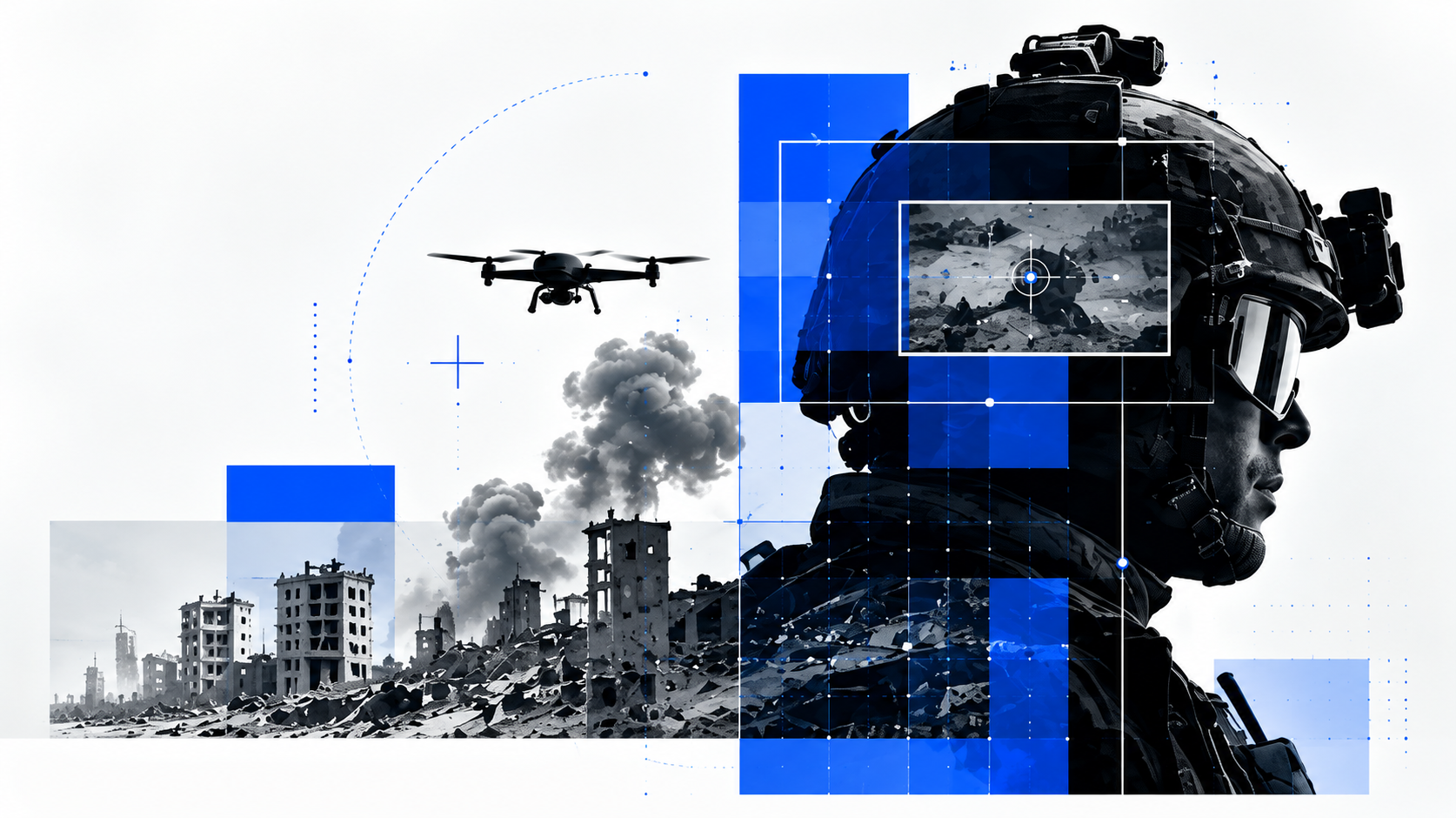
Artificial Intelligence and emerging technologies are reshaping military operations, accelerating strategic decision-making, and redefining the boundaries of technological superiority. From the Russia-Ukraine war and India-Pakistan hostilities to the US-Iran confrontation and the conflict in Gaza, recent conflicts underscore how AI is transforming modern warfare. This raises concern around AI’s growing integration across civilian, military, and political domains blurs the line between innovation and weaponisation, raising concerns about information integrity, accountability, and conflict escalation.
As Volker Türk, the UN High Commissioner for Human Rights, has warned, the urgency of AI regulation cannot be overstated. Against this backdrop, understanding the new face of conflict therefore requires examining not only how AI enhances military capabilities, but also how it enables information manipulation, expands surveillance, and challenges democratic resilience and international security. Military organisations are already exploring and using AI for areas including intelligence analysis, decision support systems, cyber operations, surveillance and autonomous weapon systems. The International Committee of the Red Cross has warned that military applications of AI could increase the speed and scale of warfare, introduce greater unpredictability, and reduce human control over the use of force, creating serious risks for civilians.
This article examines how the growing integration and accessibility of AI are reshaping warfare and international security. It argues that AI is transforming military capabilities, intensifying strategic competition, and creating new vulnerabilities through its adoption by both state and non-state actors. It explores emerging debates surrounding dual-use technologies, information manipulation, autonomous decision-making, accountability, and the risks of conflict escalation. Focusing on various events across the globe, to understand its implications for asymmetric warfare, non-state armed actors, state-led military modernisation, and the shifting balance of power in international relations.
Integration of AI in Military Operations
The war in Ukraine and Gaze have provided important demonstrations of how artificial intelligence can transform the modern battlespace, but the 2026 war between the United States and Iran represents a further development, the integration of AI into the wider architecture of military operations. During Operation Epic Fury, the United States reportedly relied on the Maven Smart System (MSS), an AI-enabled platform developed by Palantir that grew out of the Project Maven. The system is designed to bring together information from multiple sources, including surveillance, sensors, and intelligence, and assist military personnel in identifying and prioritising potential targets. By Apr 8, 2026 U.S. authorities reported that more than 13,000 targets had been struck during the first 38 days of the operations.
The significance of this development lies not simply in the number of targets struck, but in how AI is transforming the relationship between information, decision-making, and the use of force. AI is no longer merely another weapon on the battlefield it is becoming part of the infrastructure through which conflicts are interpreted and military decisions are made. This transformation raises a critical question for democracies: how can the malicious applications of AI be effectively countered and regulated?
The consequences extend beyond conventional state-to-state warfare and this is where the question becomes more unsettling, What happens when AI intersects with terrorism? The United Nations Office of Counter Terrorism has already examined the potential malicious use of AI by terrorist actors, the same capabilities that allow states to analyse intelligence and accelerate military operations may also be adapted by non-state actors for surveillance, propaganda, cyber operations, target selection and other forms of asymmetric conflict. The future of warfare may therefore be defined not simply by autonomous weapons, but by an increasingly automated decision making environment.
Terrorist Organisations and the Use of Artificial Intelligence (AI)
The potential implications of AI become particularly significant when examining its use by non-state actors. Recently, Iran-backed Houthi forces have been accused of using AI to impersonate Yemeni military commander Lieutenant General Tareq Saleh by generating an audio recording that mimicked his voice. According to Saleh’s National Resistance Forces, the alleged recording called for troops to withdraw and was circulated during fighting around the strategic port city of Mocha. The incident, which Saleh’s forces described as an attempt to create confusion and undermine soldiers’ morale, illustrates how AI-generated media can be weaponised to manipulate perceptions, spread uncertainty, and disrupt psychological resilience during conflict. Although the extent to which such tactics may become widespread remains uncertain, the episode highlights the growing role of information manipulation in contemporary warfare.
The implications extend beyond information warfare, as it also raises questions about the authenticity of digital evidence, as manipulated audio may be used to fabricate orders, deny genuine communications, or undermine the credibility of military leadership. A report by Anthropic indicates that a threat actor cell based in northern Yemen attempted to use AI to support the development of guided rockets and missiles, including employing Claude in the design of guidance software. The actors reportedly made sustained efforts to circumvent the model’s safeguards by concealing both their objectives and the intended use of the technology. The episode is significant because it illustrates how generative AI can potentially reduce the technical barriers and dependence on human resources associated with developing sophisticated military capabilities. This raises broader security and ethical concerns, as capabilities once concentrated among actors with substantial financial, technological, and human resources may become increasingly accessible to smaller groups. From an ethical perspective, this democratisation of AI raises questions about accountability, the responsible use of technology, and the risks of enabling malicious actors to inflict harm without commensurate oversight or safeguards.
The Chinese ship incident
Another incident involving the U.S. military illustrates how quickly an erroneous assessment can move through a decision making system. According to CNN, during the 2026 conflict with Iran, an intelligence report circulated within the U.S. military claimed that a Chinese vessel in the Middle East was carrying components associated with a nuclear weapons programme. The report has been produced with the assistance of an AI chatbot, which had incorrectly identified the ship’s cargo. U.S. personnel reportedly began preparing to intercept the vessel, with military aircraft already in the air, before officials examined the intelligence more closely and halted the operation.
The incident is significant not because it demonstrates that AI will inevitably produce false intelligence, but it illustrates the consequences of allowing an AI-assisted assessment to enter a high stakes decision making chain. These risks extend beyond AI hallucinations and algorithmic bias to the deliberate manipulation of information systems through disinformation, adversarial inputs, and the exploitation of AI-generated content.
AI intensifies great power rivalry by altering the distribution of capabilities and creating new forms of strategic dependence. Power is no longer measured solely by military strength or economic resources but increasingly by a state’s ability to control digital infrastructure, develop advanced AI systems, and shape the technological environment within which actors operate. This dynamic intensifies the security dilemma, one state’s pursuit of technological superiority may generate insecurity in others, triggering competitive cycles of militarisation and escalation. AI therefore represents more than a technological transformation of warfare, it challenges established assumptions about power, deterrence, and management of conflict in an increasingly interconnected international system.
Conclusion
Looking ahead, AI may increasingly shape multiple domains of warfare from information, weapons, coding, surveillance, target identification to decision-making and operations. At the same time the battlefield may extend beyond the information people consume, to the data on which AI systems themselves depend, raising concerns about deliberate data poisoning designed to influence future outputs. These developments reveal a broader shift in the technological balance of conflict, as AI can lower some of the financial and technical barriers that have traditionally limited smaller, non-state actor.
The cases discussed above demonstrate the rapid evolution and adoption of AI by both state and non-state actors in contemporary warfare. While extremist organisations have previously exploited AI for propaganda, recruitment, and radicalisation, its potential application in attack planning, weapons development, and combat operations represents a significant escalation in its malicious use. Reports of Boko Haram fighters allegedly using AI chatbots to support bomb making and operational planning, as highlighted by research attributed to the University of Cambridge, underscore the potential for these technologies to expand the capabilities of non-state armed groups. Without adequate safeguards, the proliferation of AI could accelerate military escalation, increase the risk of indiscriminate violence, and exacerbate civilian suffering, fundamentally challenging existing understandings of warfare and regulations of armed conflict.