

Role: Research Scholar, Lucknow University
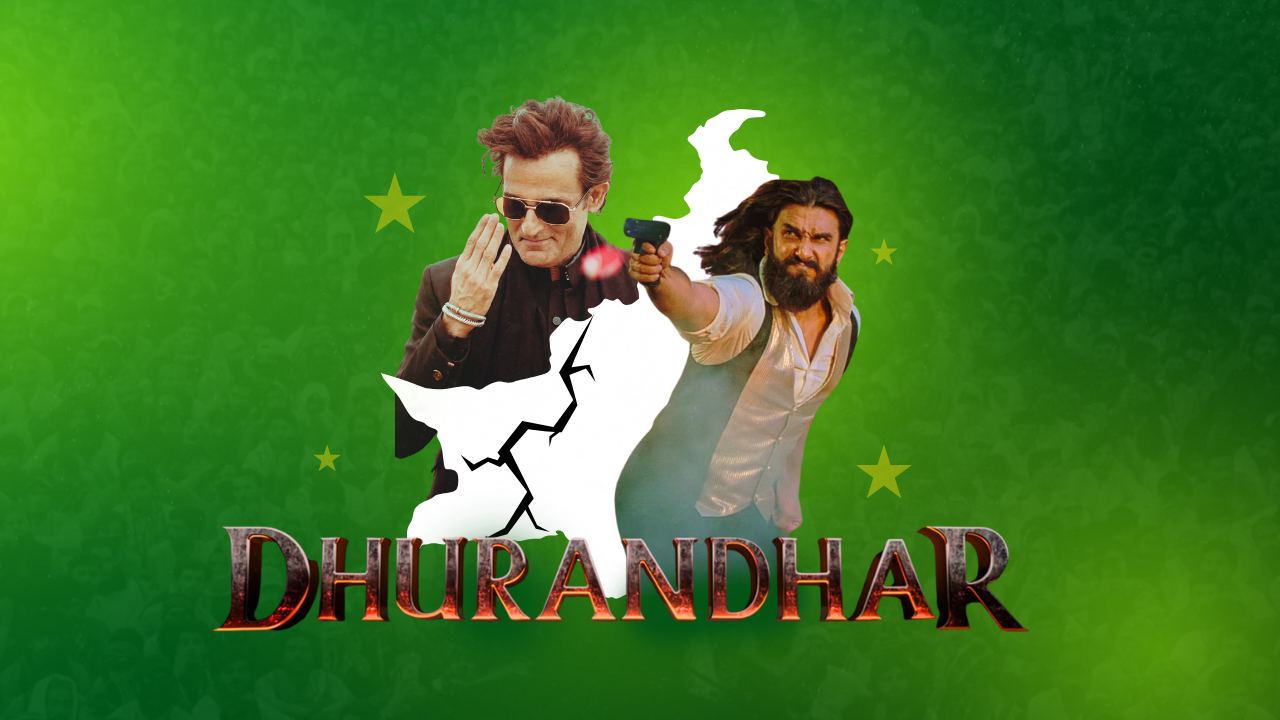
Dhurandhar stands out as a spy thriller that takes its audience seriously. Instead of falling back on Bollywood’s familiar RAW-versus-ISI template or loud, stylised action, the film builds its tension patiently, through research, carefully used archival material, and a narrative that unfolds in layers. What sets it apart is its willingness to look beyond the border and into Pakistan itself, particularly the fraught and violent world of Karachi’s Lyari neighbourhood. Aditya Dhar’s camera lingers on the city’s sounds, streets, and social textures, treating Lyari not as a backdrop but as a political space shaped by fear, power, and exclusion.
One of the film’s greatest strengths is its ability to seamlessly blend real archival footage with fiction, thereby blurring the line between documented history and cinematic imagination. This approach gives Dhurandhar a grounded realism that sustains attention across its long 212-minute runtime. At the same time, the film’s political viewpoint is impossible to miss. It has divided Indian audiences, admired by some for its clarity and criticised by others for its ideological weight, signalling a clear break from the escapist spy films Bollywood has long been comfortable making.
Kandahar and the Limits of State Action
Dhurandhar begins by returning to a moment that still carries political and emotional weight in India’s collective memory. On December 30, 1999, a day before India released the Kandahar hostages in exchange for three Pakistani terrorists, the film sets the tone for what follows. This decision becomes the narrative’s point of departure, framing the story as a reflection on restraint, consequence, and the unseen costs of state choices. At its centre is Ajay Sanyal, played by R. Madhavan, a character who, despite the film’s formal disclaimer, closely resembles National Security Advisor Ajit Doval and represents the often invisible labour of India’s security establishment.
Sanyal is depicted as strongly opposed to the decision, yet the system quietly absorbs his resistance. The film does not portray him as ineffective or indecisive; instead, it situates him within the familiar constraints of bureaucracy, political caution, and the democratic process. His frustration is measured rather than theatrical, rooted in an understanding of what delay and compromise can eventually produce. As the costs of inaction become clearer, the foreign minister, Devavrat Kapoor, a figure visually reminiscent of Jaswant Singh, finally authorises a covert response. The film handles the moment with restraint, using a subdued conversation over a shared drink to lay the groundwork for a secret operation codenamed Dhurandhar.
Under this programme, the state sends a lone operative, stripped of public identity and personal attachments, into Lyari, Karachi’s notorious gangland. Aditya Dhar presents the city without embellishment, as harsh, fractured, and violent, shaped by rival gangs, kidnappings, and everyday coercion. Running through this chapter is a quiet sense of dissatisfaction in Sanyal’s character, not as an indictment of the government, but as a reflection of how slowly and cautiously states often move when confronted with crises that demand clarity and resolve.
Lyari as a Political Ecosystem
Under the Dhurandhar programme, Ranveer Singh’s entry as Hamza Ali Mazari marks a clear shift in the narrative, emerging naturally from Ajay Sanyal’s earlier frustration with the limits of institutional action. The film presents Hamza’s Baloch identity not as a disguise of convenience, but as a structural necessity. Within Pakistan’s ethnic landscape, the Baloch occupy an uneasy position, viewed as too militant to be fully absorbed and too marginal to be accommodated. The film suggests that this long history of suspicion makes them the most credible presence in a space where gangs, political brokers, and intelligence handlers constantly overlap.
Aditya Dhar underlines this reality through Sanjay Dutt’s SP Choudhary, whose hostility is institutional rather than personal. His blunt remark, ‘Magarmachchh par bharosa kar sakte hain, par Balochon par nahi’ (‘You can trust a crocodile, but not the Baloch’), captures a policy of state distrust toward the Baloch and reveals how Baloch identity itself is treated as a security problem. Within this framework, Hamza does not need to perform dissent; anger toward the Pakistani state is already assumed, making his cover immediately legible and convincing to those around him.
Lyari, in turn, is portrayed not as the territory of a single gang but as a fractured arena where multiple groups compete for influence. The film demonstrates that control over the neighbourhood holds both symbolic and strategic importance: whoever commands Lyari gains leverage over Karachi and, with it, a foothold in Pakistan’s broader power structure. This logic explains why the area becomes central to the covert operation. Akshaye Khanna’s Rehman Dakait, a Baloch gang leader deeply embedded in Lyari’s violent underworld, embodies this convergence of local authority and ethnic marginalisation. It is into this charged space that Hamza seeks entry, deliberately aligning himself with a Baloch faction rather than a more negotiable criminal group.
The Baloch Question and the Shadow State
It is within Lyari’s volatile landscape that Hamza’s inner conflict begins to take shape. The same conditions that make a Baloch identity a convincing cover, state suspicion, routine coercion, and long-standing political exclusion, also feed his growing discomfort with the compromises unfolding around him. The Pakistani state’s reliance on force to suppress Baloch dissent gives weight to Hamza’s anger when he confronts Rehman Dakait for entering into a tactical understanding with Arjun Rampal’s character, ISI Major Iqbal, to procure weapons for attacks against India.
At this stage, his resistance remains mainly strategic. Hamza’s objection is driven less by moral outrage than by the need to preserve the credibility of his assumed identity. Dhurandhar, however, is careful to show that this strategic posture does not remain fixed. Gradually, it gives way to a more profound moral reckoning. The film conveys this shift by exposing Hamza to the human cost of the conflict, stories of water wells allegedly poisoned by the Pakistan Army, villages falling ill, and deaths that pass quietly without recognition.
Ranveer Singh communicates this transformation with restraint, through silence, a clenched jaw, and fleeting expressions of grief, allowing the weight of these moments to settle without overt dramatics. What begins as a calculated intelligence operation is slowly humanised, and Hamza’s alignment with the Baloch moves from tactical necessity to moral commitment. This transition also clarifies the film’s broader political argument. The decades-long insurgency in Balochistan explains why Major Iqbal turns to Baloch networks within Lyari for arms and operational support, suggesting that groups shaped by prolonged repression possess both the experience and infrastructure required for deniable operations.
Through the interactions between Rehman Dakait and Major Iqbal, Dhurandhar exposes a troubling contradiction at the heart of Pakistan’s security apparatus. Even as the ISI wages a relentless campaign against ethnic Balochs, it remains willing to set aside ideological hostility through transactional alliances. Dakait, driven by personal political gain, cooperates despite the cost to his own community. At the same time, Major Iqbal exploits religion as a shared language to bridge ethnic divisions when it serves strategic ends. In doing so, the film shows how actors instrumentalise faith to obscure internal violence while sustaining both domestic control and cross-border proxy warfare.
Dhurandhar as Soft Power: Packaging a National-Security Worldview
Dhurandhar also serves as a form of soft power, albeit in a quieter and more contemporary manner. By placing an Indian national-security worldview within a globally familiar genre, the undercover espionage thriller, the film avoids overt political messaging and instead presents its perspective as practical realism, shaped by experience rather than ideology. The film reinforces this effect by repeatedly using archival footage and documentary-style inserts that recall widely remembered terror attacks. By anchoring its narrative in shared memory, the film transforms collective trauma into a moral context, framing the conflict not as one challenge among many, but as a persistent civilizational threat that, in the film’s logic, calls for exceptional responses.
Notably, the debate surrounding Dhurandhar, variously described as propaganda, politically blunt, or simply reflective of a national-security mindset, has only amplified its reach. The controversy expands visibility, while the film’s internal moral coherence quietly guides viewers toward a particular way of reading events without explicit persuasion. In this sense, Dhurandhar functions less as a direct argument and more as a narrative environment, one that normalizes a security worldview by making it feel familiar, reasoned, and challenging to dismiss.
Conclusion: Beyond Espionage, a Political Mirror
Dhurandhar succeeds not by offering neat answers but by reshaping how it frames questions of security, morality, and state power. By placing its espionage story within Pakistan’s internal fractures, Lyari’s gang politics, the marginalization of the Baloch, and the contradictions of the security establishment, the film moves away from the familiar India-versus-Pakistan binary. Violence is shown less as an external imposition and more as something sustained by unresolved domestic structures. Within this framing, India’s role emerges as watchful and restrained, shaped by experience rather than impulse.
The film does not claim political neutrality, and it states its perspective clearly, sometimes uncomfortably so, yet it derives its effectiveness from how it communicates that perspective. Instead of slogans or spectacle, Dhurandhar relies on realism, procedural detail, and a slow moral progression. In a genre often dominated by noise and certainty, it opts for patience and quiet conviction. Whether seen as a serious political thriller, an exercise in soft power, or a contested national-security narrative, Dhurandhar leaves a lasting impression not by insisting on agreement but by presenting its interpretation in a way that feels coherent, grounded, and hard to dismiss.