

Introduction
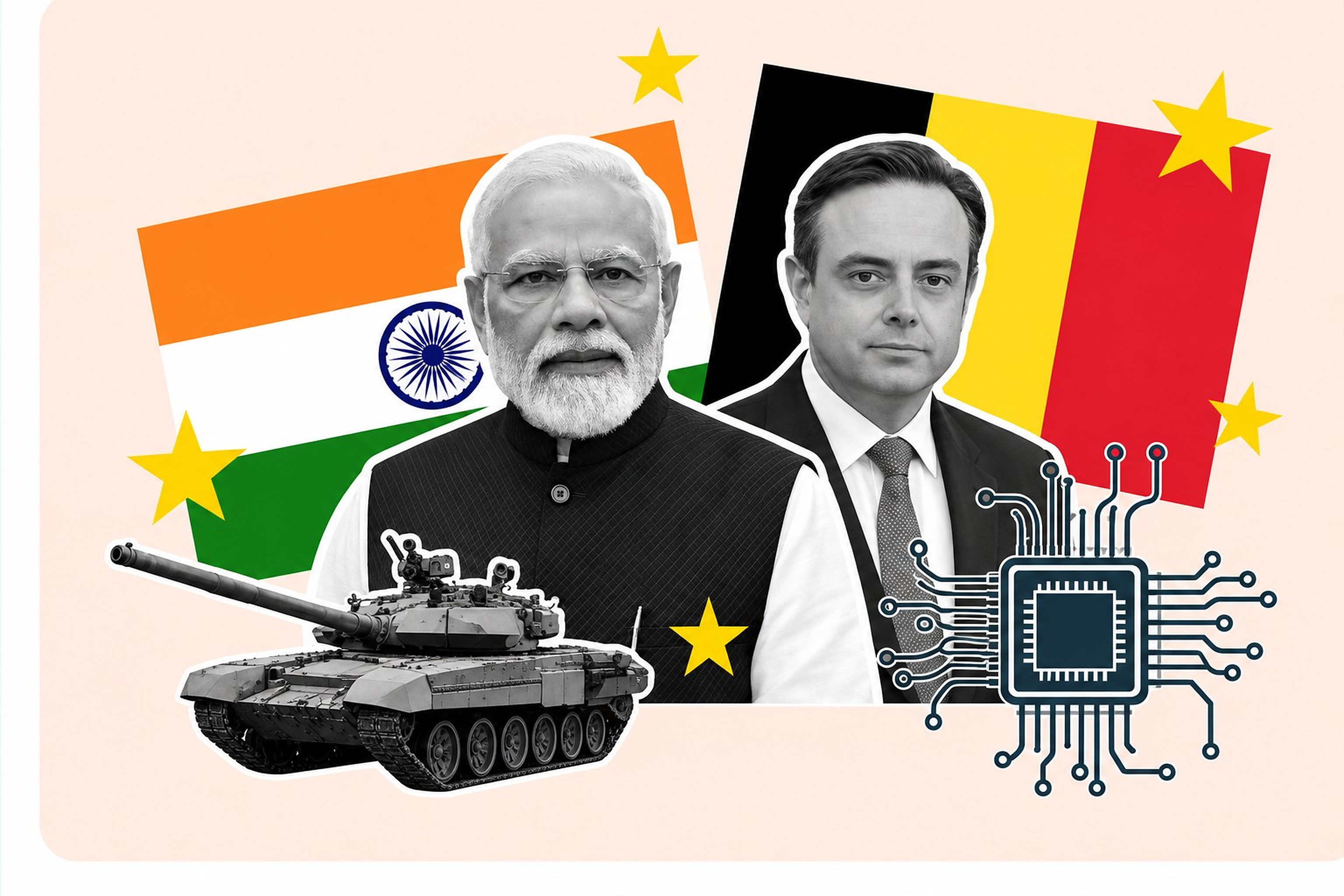
The recent official visit of the Prime Minister of the Kingdom of Belgium, H.E. Mr. Bart De Wever, accompanied by Belgium’s Minister of Defence and Foreign Trade, H.E. Mr. Theo Francken, along with a high-level delegation of government officials and business leaders, marked a new chapter in India-Belgium relations and bilateral cooperation. Over the course of the three-day visit from 2-4 September, discussions covered the full breadth of India-Belgium relations, encompassing a wide range of areas of mutual interest and cooperation. The leaders recalled the shared historical ties between India and Belgium, including the sacrifice of more than 9,000 Indian soldiers in Flanders during the First World War and Belgium’s establishment of diplomatic relations with India in 1947. They reflected that the relationship has since grown on the foundations of shared democratic values, mutual trust, economic complementarities, strong people-to-people ties, and expressed their commitment to further deepening the partnership.
Building on their shared interests, mutual trust, and democratic values, the two countries are set to further deepen and expand their bilateral partnership. The relationship is now evolving into a multidimensional relationship, expanding across diverse areas of cooperation between the two countries. The central pillars of the emerging partnership include defence and security, trade and economic cooperation, industrial cooperation, emerging technologies and innovation, the green transition, healthcare, mobility and connectivity, and people-to-people ties. These developments reflect the widening and deepening of India-Belgium bilateral cooperation.
Defence and security cooperation
A significant development has been the strengthening of defence and security cooperation, particularly in counterterrorism. Belgium reaffirmed its solidarity with India in combating terrorism, including cross-border terrorism, and condemned the April 2025 Pahalgam terrorist attack. Both leaders stressed the need for a comprehensive international approach to counterterrorism and called for collective action against terrorist organisations, through existing international frameworks such as the UN and FATF. With this objective, both leaders expressed their intention to explore the establishment of a Belgium-India Joint Working Group on Counter-Terrorism in addressing evolving terrorist threats. Belgium also firmly assured India that it would not pursue defence cooperation or provide technological assistance to Pakistan.
It is also notable to highlight that, India and Belgium are strengthening its institutional and law-enforcement cooperation through an MoU between India’s Central Bureau of Investigation (CBI) and Belgium’s Federal Police to combat transnational organised crime and cybercrime. The agreement aims to strengthen institutional linkages through information sharing, capacity building, the exchange of best practices, and enhanced cooperation in tracing fugitives. This clear commitment reinforces Belgium’s strategic trust in India and strengthens the foundation of their defence partnership.
A major turning point in the partnership is the institutionalisation of bilateral defence cooperation through the signing of a Letter of Intent between the two Defence Ministries. The framework moves cooperation beyond political commitments by establishing regular staff talks, exchanges, education and training, research collaboration, and defence-industrial partnerships. Building on the understanding reached by the two Defence Ministers in March 2025, the agreement provides a structured foundation for a deeper and more sustained India-Belgium defence partnership. This marks a significant shift in the India-Belgium defence relationship, which has traditionally been driven by private-sector cooperation, towards a formalisation of government-to-government framework, paving the way for deeper institutional and strategic engagement.
Belgian Defence Minister Theo Francken emphasised that India is “a rapidly growing economy and a major military power in the Indo-Pacific,” underscoring Belgium’s recognition of India’s growing geostrategic importance and cooperation in maritime security. This reflects a broader European recalibration towards the Indo-Pacific, with Belgium increasingly viewing India as a key strategic partner in a changing regional and global security order. The participation of at least 15 Belgian defence companies in the delegation sends a clear signal that India and Belgium are moving towards a concrete partnership in defence-industrial cooperation.
The defence partnership underscores the central role of the Zorawar in India’s defence outreach to Belgium. Prime Minister Modi has underscored how India and Belgium are working together towards the development of modern defence equipment. The Zorawar is India’s first indigenous light tank, and has been specifically designed for high-altitude warfare in the Himalayas, particularly in the context of India’s security challenges along its border with China. The Zorawar represents a significant convergence of indigenous Indian defence development and Belgian defence technology within the evolving bilateral partnership. This cooperation gained further momentum in March 2025, when Belgium’s John Cockerill Defence entered into a joint venture with Pune-based Electro Pneumatics and Hydraulics to manufacture the Cockerill 3105 turret in India, the company’s first production line outside Europe. The partnership aligns closely with India’s “Make in India” drive and demonstrates how Belgium is becoming an increasingly important partner in India’s efforts to strengthen indigenous defence manufacturing and technological capabilities.
Beyond the Zorawar partnership, India-Belgium defence-industrial cooperation is emerging as an important pillar of India’s defence modernisation efforts, strengthening domestic capabilities while expanding access to advanced technologies and strategic partnerships. The participation of 15 Belgian companies in the delegation underscores the growing depth of India-Belgium defence-industrial cooperation. To cite few, the partnership between New Lachaussée and Tembo Classic Engineering will provide India with a complete production line for two ammunition calibres, along with tooling for two additional calibres, strengthening India’s domestic ammunition manufacturing capacity. In the maritime domain, Belgium’s Exail is partnering with Larsen & Toubro, which is building mine countermeasure vessels for the Indian Navy. Exail will provide autonomous toolboxes capable of detecting, identifying and neutralising naval mines, bringing advanced mine-warfare technologies into India’s naval modernisation efforts. Together, these partnerships demonstrate a shift towards deeper industrial and technological cooperation, extending beyond defence procurement to the development of indigenous manufacturing and advanced operational capabilities.
The two sides are also taking India-Belgium defence diplomacy to the next level by strengthening the institutional architecture of their security engagement. Belgium’s appointment of a Defence Attaché in New Delhi, and India’s decision to appoint a resident Defence Attaché at its Embassy in Brussels, will establish dedicated channels for sustained military-to-military engagement. This institutional deepening is complemented by growing cooperation between the two defence establishments on maritime security, emerging technologies and the Indo-Pacific, signalling a shift from episodic defence engagements towards a more structured and strategically oriented defence partnership.
Economic Cooperation
Belgium’s recent recognition of the risks of overdependence on China adds a strategic dimension to India-Belgium economic relations. Prime Minister Bart De Wever’s remark that Europe has had a “rude awakening” over excessive dependence on China and that India had warned European leaders of this risk . The growing convergence between European Economic security concerns and India’s strategic outlook can be attributed to China. The dominance of China in Asia and its position as the manufacturing hub of the world is now being used as a political leverage; China’s industrial overcapacity, dumping has now led the other economic states to pursue supply-chain diversification and seek trusted partners. India increasingly fits into this role as it not only offers a large market, a growing manufacturing base, diversified supply chains but also greater willingness to develop.
However the trade showed a boom-and-correction pattern between 2021 and 2025. Trade expanded strongly in 2022, with Belgian exports reaching 7 billion and imports from India €8.2 billion, but both declined steadily thereafter. The trade balance also shifted from near equilibrium in 2021 to persistent Belgian surplus, reaching €1.9 billion in 2024 before narrowing to €1.5 billion in 2025. This suggests that while bilateral trade remains significant, the post-2022 moment has weakened, reflecting softer global demand and changing trade conditions.
While overall trade has moderated after the 2022 peak, the composition of trade reveals greater economic depth than the headline figures suggest. India’s imports from Belgium stood at US$6.59 billion in FY25 and US$4.44 billion in FY26 up to November 2025, comprising machinery, precision instruments, pharmaceuticals, chemicals, electrical equipment and automotive components. This indicates that the relationship is not merely diamond driven, but increasingly linked to India’s industrial and technological requirements.
Overall, India and Belgium share significant and diversified trade ties. In 2023, India was Belgium’s 16th biggest customer (€4.9 billion) and 18th biggest supplier (€6.5 billion) of goods. India’s exports to Belgium stood at US$4.38 billion in FY26 (till November 2025), compared with US$6.32 billion in FY25, covering 3,397 commodities. Major exports included pearls and precious stones, iron and steel, organic chemicals, fish and aquatic products, tobacco, pharmaceuticals, and vehicles and auto components.
This creates a potential geo-economic convergence between India and Belgium. For Belgium and Europe, India can become part of a China+1 diversification strategy, particularly amid efforts to reduce overdependence on China and pursue economic decoupling. This could open greater opportunities for India in European supply chains, manufacturing, and strategic sectors. This also reduces excessive dependence on a single external supplier, and provides India a deeper Belgian engagement that can provide access to European technology, capital, logistics, networks and advanced manufacturing capabilities. However, India should avoid simply replacing “dependence on China” with “dependence on another external partner.”
Other Forms of collaboration
Semiconductors represent another important dimension of the emerging India-Belgium strategic partnership, particularly because of their growing significance for both economic and national security. The two leaders encouraged deeper engagement between India’s micro-electronics ecosystem including semiconductor companies, the ChipIN Centre, C-DAC and Indian universities and Belgium’s Interuniversity Microelectronics Centre (IMEC), one of the world’s leading research and innovation hubs in semiconductor and nanoelectronics technologies. The proposed linkage could provide India with greater access to advanced semiconductor research, process technologies and industry collaboration as the country seeks to move beyond assembly and packaging towards higher-value segments of the semiconductor value chain. India’s growing manufacturing scale and expanding semiconductor ecosystem complement Belgium’s technological and research capabilities. As Prime Minister Narendra Modi noted, “Belgium’s expertise in semiconductors and India’s scale are complementary to each other. In this direction, we will work together to connect Belgium’s IMEC Institute with India’s semiconductor ecosystem.” Such a partnership could strengthen India’s technological capabilities while creating new avenues for joint research, innovation and industrial collaboration in strategically critical sectors.
The future of the India-Belgium semiconductor partnership will depend on how effectively both sides turn agreements into practical projects. Key factors include sustained funding and research cooperation between institutions such as imec, ChipIn Centre and C-DAC, the successful conclusion of the India-EU FTA, and India’s ability to develop the skilled workforce and infrastructure needed to use advanced semiconductor technology. Geopolitical efforts to reduce dependence on China could further strengthen the partnership and encourage similar cooperation with other European countries.
In addition to this, green hydrogen and offshore wind to universities, healthcare and easier mobility, India-Belgium ties are expanding beyond traditional trade and diplomacy. The two countries renewed their MoU on renewable energy, which builds on the cooperation initiated under the 2015 framework and the work of the Joint Working Group on Renewable Energy, while broadening collaboration across key areas such as green hydrogen, solar energy, energy storage, offshore wind, bio-energy, small hydropower and pumped storage projects. India and Belgium reaffirmed their commitment to the Paris Agreement and its long-term climate goals, while stressing the importance of climate finance, technology transfer and capacity-building, particularly for developing countries. The two sides also agreed to strengthen cooperation on climate adaptation, resilience and disaster preparedness. Recognising the role of oceans and coastal ecosystems in climate resilience and sustainable development, they highlighted the importance of ocean governance, the BBNJ Agreement and wider international cooperation on maritime issues.
The people's dimension of the relationship is also becoming more strategically relevant, particularly as Belgium seeks skilled talent and India seeks greater access to European education and professional opportunities. Migration and Mobility Partnership between the two could reduce practical barriers to these exchanges. Prime Minister Narendra Modi said that India and Belgium would soon conclude a Migration and Mobility Partnership Agreement covering skilled professionals, students and researchers. India’s invitation to Belgian universities to establish campuses in India also points towards deeper institutional and knowledge linkages, rather than mobility being limited to individuals. The two sides also highlighted growing healthcare cooperation, particularly initiatives supporting the mobility of qualified Indian nurses to Belgium, while agreeing to advance discussions on a Mobility and Migration Partnership Agreement.
Conclusion
The India-Belgium relationship is beginning to acquire a significance that extends beyond the traditional scope of bilateral ties. Their shared commitments to democracy, the rule of law and a rules-based international order provides a steady political foundation. Their bilateral relations are entering a more substantive and strategically consequential phase. What distinguishes the current phase is that the renewed momentum is increasingly being translated into concrete frameworks, institutional mechanisms and sector-specific initiatives. The relationship is therefore not being driven by a single factor, but by the convergence of multiple interests. The cooperation is expanding beyond traditional trade and diplomacy into energy, green hydrogen, critical minerals, technology, healthcare, education, mobility and maritime cooperation.
This convergence is also shaped by wider geopolitical shifts: concerns over China-related economic dependencies and supply-chain vulnerabilities are creating greater scope for India to serve as a trusted partner in European economic diversification, while instability in West Asia is reinforcing the importance of resilient supply chains, secure energy flows and diversified strategic partnerships. This broader alignment gives the relationship greater strategic depth. For Belgium and Europe, India offers a potential partner in diversifying economic dependencies and strengthening resilient supply chains, while India gains from deeper access to European markets, technology, investment and expertise. The trajectory suggests that India-Belgium ties are evolving from a largely transactional relationship towards a more multidimensional and strategically anchored partnership.