

Introduction
Trade is the grand engine of human intercourse.” — Adam Smith, The Wealth of Nations (1776)
Trade has always remained more than an exchange of goods, from silk route to colonial mercantile routes that shaped global empires, trade has been an instrument of power diplomacy and identity. Trade has historically served the purpose of prosperity and strategic assertion of influence. In the 21stcentury this dynamic persists however in a new form where trade agreements are now tools of geoeconomic statecraft.
According to UNCTAD’s 2024 Trade and Development Report, the world is witnessing “slowbalisation” a fragmentation of global trade driven by technological rivalries, supply‑chain reorientation, and strategic decoupling between major powers. In this landscape trade goes beyond the definition of tariffs and becomes more about data flows, AI, and digital governance. The 2025 edition of the World Trade Report reveals that, with the right enabling policies, artificial intelligence (AI) could boost the value of cross‑border flows of goods and services by nearly 40% by 2040 thanks to productivity gains and lower trade costs. This highlight that technological empowered economies would like to retain their large share of profit through these advancements and the new emerging powers will converge to maximize the benefits of the given opportunities through these developments.
Trade Realities with India’s Partners‑ UK AND EU
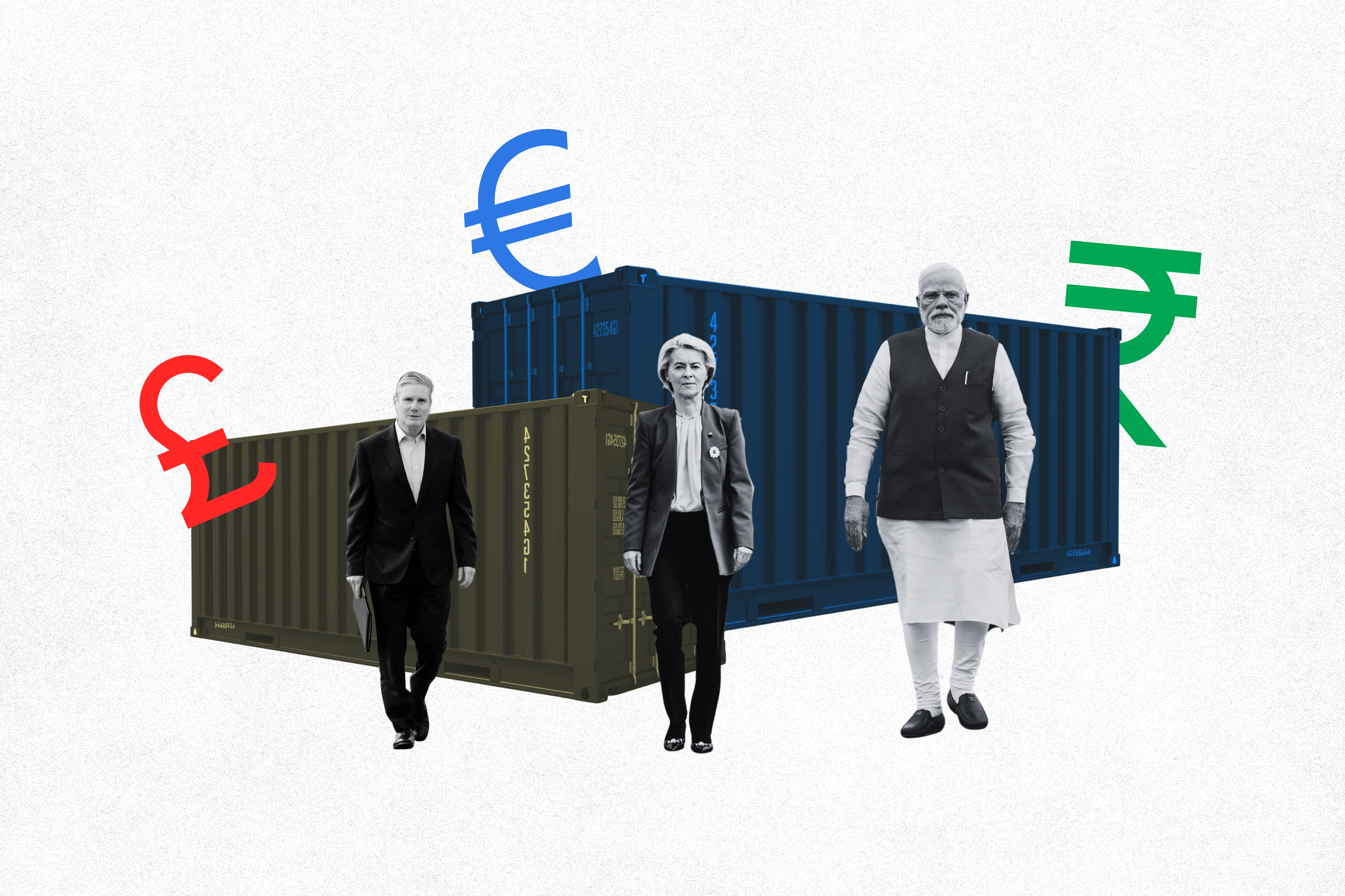
This decade of trade agreements between India and its economic partners like EU and UK goes beyond the avenues of tariffs alone. To match with the contemporary realities, the agreements tend to contest to shape rules for digital trade, control of data information, cross border AI governance, and the resilient tech‑ driven supply chains. The mercantile nature of the trade negotiations that were imbedded in talks related to market access always have remained a geopolitical instrument to shape strategic interests of the country and now they are the becoming forthcoming factors that determine who capture value from the AI and innovation economies in the 2020s.
The UK India free trade agreement was concluded in July 2025 projecting a strong material gain in bilateral trade relations highlighting deepening of strategic economic alignments between the two partners. The EU – India FTA talks are getting fast tracked especially after the release of joint communique and the high‑level diplomatic visit from Brussels to India recently and subsequent visit by Indian Minister of commerce and industry Mr. Piyush Goyal to Brussels. The trade deals are paving pathways for rules that govern cross border digital data flows, localization clauses, and the treatment of ai enabled products, these pressing issues are consequential for growth along with incremental tariff mechanisms.
EU AI Act vs the UK’s AI regulation
Digital trade and data flows are now a new battleground along whose lines countries are devising their strategic policies. digital trade rules hence become central in FTA negotiations. The demand for frictionless cross‑ border data transfers and interoperability of regulations is every increasing. However, governments insist on sovereignty, security, and industrial policy space under these trade talks to secure the best possible deal for themselves.
The dynamism of these trade delas unfolds in variety of ways. For instance, the digital service exporters require a predictable transfer mechanism in terms of adequacy, contacts, or certifications. Secondly, India amidst all these trade negotiations is still emphasizing on domestic capacity building, research infrastructure, and technology transfers.
For UK and EU, securing assured access to Indian markets and talent means negotiating protections for IP, cross border research collaboration. In turn for India, the leverage lies in conditional market opening: concession on services, procurements access or investment can be traded for technology transfer commitments joint R&D frameworks or relaxed data export rules for accredited partner. in short, FTAs become channels for building innovation ecosystems not simply market access tools.
STATISTICS AT GLANCE
INDIA UK
On 6 May 2025, India and the UK took a significant step in their bilateral relations by finalizing a landmark Free Trade Agreement (FTA) .
• The UK‑India Free Trade Agreement allows elimination of tariffs on 99% of Indian tariff lines and reducing tariffs on 90% of UK tariff lines
• The FTA could support job creation in India, promote technology transfer, investment, and innovation across labor‑intensive sectors.
• The FTA is expected to boost Indian participation in IT, finance, and digital trade services through commitments on services and professional mobility.
This deal was hailed by the Indian government as ambitious, historic, and transformative. For India, sectors such as textiles, marine products, leather, and engineering goods stand to gain immensely.
The trade agreement between UK and India has also placed special emphasis on mobility enhancement of both professionals and services and this gives competitive edge to particularly Indian sectors like IT. The India–UK FTA unlocks strategic advantages for businesses in both countries. Beyond reducing tariffs, it facilitates smoother customs processes, enhances mobility, and creates new opportunities in government procurement and digital trade.
INDIA EU
The EU is India’s largest trading partner, accounting for €124 billion worth of trade in goods in 2023 or 12.2% of total Indian trade. India is the EU’s 9th largest trading partner, accounting for 2.2% of the EU’s total trade in goods in 2023. Trade in services between the EU and India reached €59.7 billion in 2023, The trade negotiations aim to:
• Remove barriers and helping EU firms – especially smaller ones – to export more;
• Open up services and public procurement markets;
• Ensure protection of geographical indications;
• Pursue ambitious commitments on trade and sustainable development
Trade picture:
• The EU is India’s second‑largest trading partner, accounting for trade in goods worth €120 billion in 2024, or 11.5% of India’s total trade. India is the EU’s 9th largest trading partner, accounting for 2.4% of the EU’s total trade in goods in 2024, well behind the USA (17.3%), China (14.6%) or the UK (10.1%). Trade in goods between the EU and India has increased by
almost 90% in the last decade.
• The EU’s imports from India comprise mainly machinery and appliances, chemicals, base metals, mineral products, and textiles. The EU’s main exports to India consist of machinery and appliances, transport equipment, and chemicals.
• Trade in services amounted to €59.7 billion in 2023 (with a deficit for the EU of €7.9 billion).
• The EU’s share of foreign direct investment (FDI) stock in India reached €140.1 billion in 2023, up from €82.3 billion in 2019, making the EU a leading foreign investor in India. The stock of India’s FDI in the EU was €10.2 billion.
• Some 6,000 European companies are present in India.
Conclusion
The players of this free world order are in a prism that conveys integration yet competition, bilateral profit sharing yet multilateral converging policies and under these confrontation lies the larger question of “nation interest” that drives the vehicle of diplomacy, contestation, and collaboration. Economics is intricately embedded in the core of political vehicle of the state and history being its witness, the aspect of trade has laid the premise for the fall and rise of many great empires. Presently, the global trade architecture is undergoing subtle, yet profound transformation free trade agreements have moved beyond simply about tariff and quotas rather they are now emerging as avenues to govern about data flows, digital services, ai enabled products and resilient supply chains that survive the era of geopolitical competition. Hence, the instances of weaponization of trade in today’s context are witnessed and seem to follow some historical precedence.
The new world order with strategic autonomy and economic strength are the driving forces behind the India’s vison of becoming a normative anchor in this century. India’s aspirations of forging a new era of leadership comes with India evolving its role as a global arbitrator where balancing geopolitics and globalization in a fragmented world is critical. India’s commitment to multilateralism needs to balance with the emerging demands of national sovereignty.