

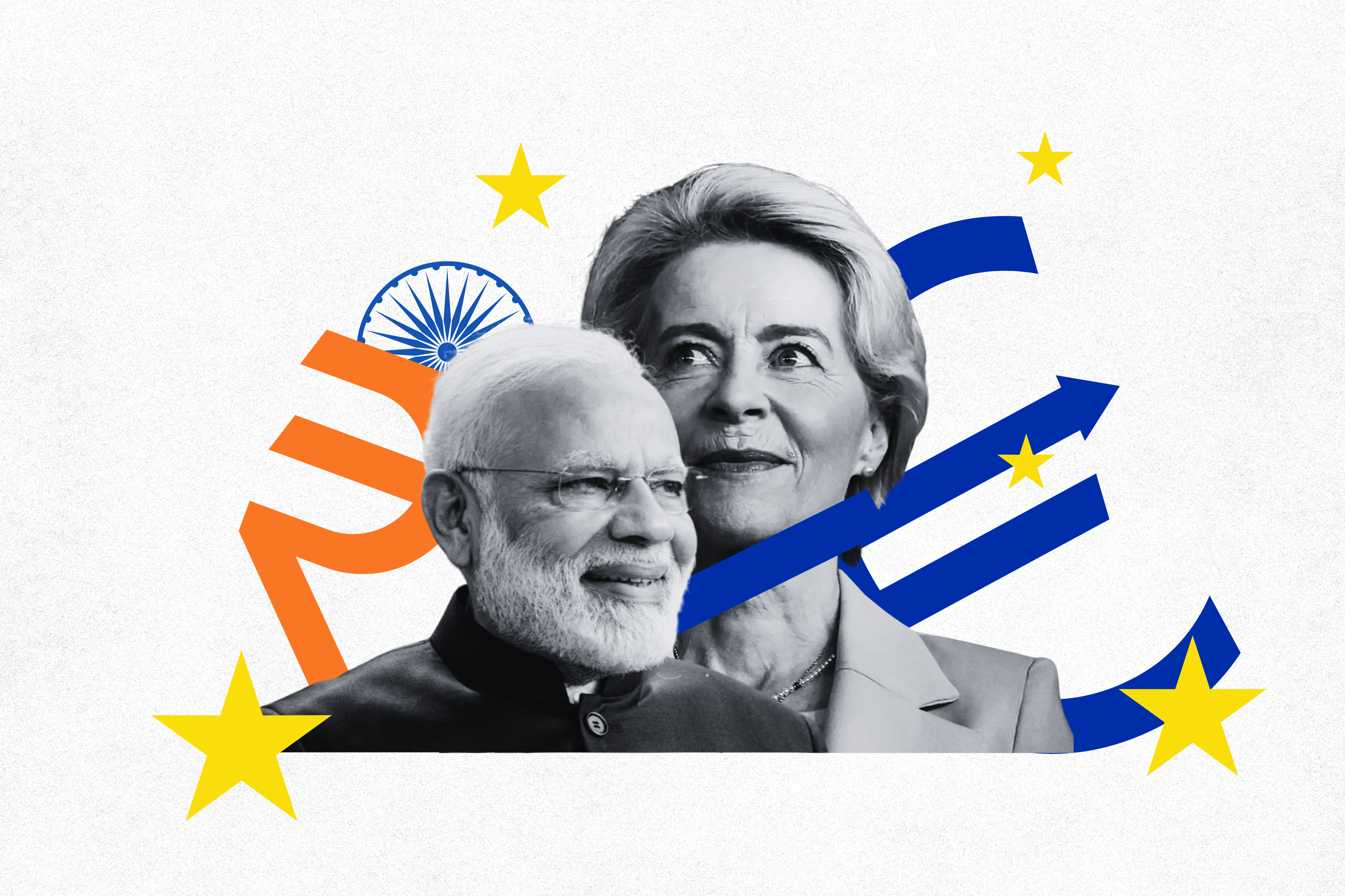
As India and the European Union (EU) aim to conclude a Free Trade Agreement (FTA) by the end of this year, negotiations are still on in the backdrop of geopolitical shifts in the international liberal trade order.
Rarely has the India–EU relationship carried this much strategic and economic weight, from both the EU’s and India’s perspectives. Together, India and the EU account for nearly $22.7 trillion, which is approximately a quarter of global GDP and share a common interest in stable supply chains, diversified markets, and a multipolar international order. There is mutual interest in signing the FTA, which reflects Delhi’s and Brussels’ economic ambitions and political realism.
The EU is India’s second‑largest trading partner for goods: trade in goods with the EU was about €120 billion in 2024, representing ~11.5 % of India’s total trade in goods, while India is the EU’s 9th largest trading partner for goods in 2024, accounting for ~2.4 % of the EU’s total goods trade. The formal negotiations for an India‑EU free trade agreement started as early as 2007, which was then called the Broad‑based Trade and Investment Agreement (BTIA). Further negotiations proceeded till 2013‑14, but after that, they stalled due to serious differences on both sides. India rejected aggressive tariff liberalisation to safeguard its domestic industries, while the EU demanded deeper market access for goods and services, as well as greater access to public procurement. A combination of strong divergences on regulatory issues, market access, and aggressive liberalization, along with procurement rules, meant that no tangible progress was made, and negotiations stalled.
A New Strategic Context
After nine years of inertia, both sides formally resumed FTA negotiations in 2022. A renewed sense of urgency in Brussels and New Delhi emanates from a fundamental shift in the geopolitical landscape. During the COVID‑19 pandemic, the world witnessed a more assertive China weaponising its dependencies on the global supply chain. This was followed by President Donald Trump’s deliberate attempt to break the international trade order, not only waging a tariff war against China but also against traditional allies. So both sides viewed the revival of FTA talks as a hedge against an increasingly volatile geopolitical landscape. Therefore, the EU‑India FTA project was no longer a mercantilist venture; it became a geopolitical necessity.
From India’s perspective, a central factor was growing concern about China’s rising influence and the deterioration of bilateral relations, especially after the Galwan clashes. These developments nudged India to build closer ties with trusted and democratic partners. The EU, as a large and rules‑based market with advanced technological capacity, offered India an important opportunity to diversify its economic links and reduce excessive dependence on China‑centred supply chains. Additionally, after India’s withdrawal from RCEP in 2019, New Delhi sought alternative economic opportunities to support its manufacturing ambitions and export growth. In this backdrop, restarting negotiations with the EU became an essential step in strengthening India’s strategic and economic quest for reliable partners.
On the EU’s part, the decision to revive the FTA talks signals a shift in Brussels’ strategic assessment of evolving geopolitical realities. As the EU’s differences with China on core issues—of unsustainable trade deficit and reciprocal access to the market—grew, Brussels formally labelled Beijing as a competitor and systemic rival in its 2019 Strategic Outlook. Since then, the weaponisation of the supply chain and coercive non‑market practices by Beijing have pushed Europe to accelerate “de‑risking”—an attempt to diversify its dependencies away from China. For Europe, deepening economic engagement with the Indian economy is central to building diversified markets beyond China.
A successful FTA would provide a stronger institutional framework to ameliorate the geopolitical uncertainties. For India, closer technological engagement with Europe reduces its vulnerability to Chinese supply chains by increasing cooperation and investment. Apart from trade dominance, both sides worry about China’s dominance and potential weaponisation of semiconductors and critical minerals. Therefore, the India–EU Trade and Technology Council (TTC) exclusively focuses on semiconductors and critical minerals. For Europe, deeper trade ties with the Indian economy offer a reliable partner as a long‑term hedge against risk. In this sense, the FTA is part of a broader geopolitical realignment where mutual geopolitical trust translates into economic frameworks.
Market Access: The Heart of the Bargain
So far, fourteen rounds of negotiations have been concluded, achieving common ground on sanitary and phytosanitary measures (SPS) and Rules of Origin (RoO). Rules of origin are criteria used to determine the national origin of a product in trade, ensuring that goods are genuinely produced within the partner country to receive preferential tariff benefits. SPS measures are health and safety standards for food safety, animal health and disease control. However, market access remains the most politically sensitive part of the negotiation. For India, the EU’s demands on tariff liberalisation are steep. European exporters are seeking drastic cuts in India’s high tariffs on automobiles, wines and spirits, and dairy products. India, however, protects these sectors due to domestic political sensitivities and the need to defend vulnerable small manufacturers.
On the other hand, India wants deeper European market access for its textiles, leather, pharmaceuticals, and services. In the services sector, New Delhi is invested in facilitating easier mobility for skilled professionals, a demand that the EU hesitates in approving, considering domestic labor market concerns and politics around migration. As the EU insists on stronger enforcement of intellectual property rights, greater transparency in public procurement, and higher food safety standards, India sees some of these as potential non‑tariff barriers. Meanwhile, the EU considers regulatory barriers such as quality control orders (QCOs) with the same lens. Common ground would require gradual liberalisation and greater regulatory cooperation.
The Sustainability Challenge: CBAM and Labour Standards
The biggest structural roadblock, however, is the EU’s sustainability agenda. The EU has taken aggressive action on climate‑linked trade measures, notably the Carbon Border Adjustment Mechanism (CBAM). Under CBAM, the EU applied a carbon tariff on imports of carbon‑intensive sectors, such as steel, aluminium, cement, and fertilisers. It aims to create a level playing field between EU‑produced goods, which already comply with emission norms, and imported goods outside the EU that are exempt from carbon pricing obligations.
India has criticised CBAM as a protectionist measure disguised as an environmental tool. It not only raises the compliance burden on Indian steel and aluminium exporters but also violates the principles of common but differentiated responsibility (CBDR). The FTA must therefore negotiate a realistic CBAM transition framework with technology assistance, to support India’s decarbonisation efforts. Without this, Indian exporters will face severe competitiveness challenges in the EU market.
Labour and human rights standards represent another major divergence. The EU’s new Corporate Sustainability Due Diligence Directive (2024) requires companies to monitor and mitigate labour violations across supply chains. Brussels wants strong sustainability and labour chapters in the FTA, while India prefers flexibility. This is another compliance cost burden, similar to CBAM, for Indian firms. A pragmatic compromise might involve India accepting a moderate sustainability chapter aligned with ILO conventions and climate goals, while the EU supports capacity‑building programmes for Indian SMEs.
Domestic Constraints on Both Sides
Despite the political convergences on multiple issues, such as RoO, trade in goods and SPS chapter closure, domestic politics on both sides complicate further negotiations. In India, the agriculture sector, MSMEs, and manufacturing lobbies fear competition from European goods. India is particularly cautious about commitments that might restrict its industrial policy support, adopted under the broader framework of “Aatmanirbhar Bharat”, such as the Production‑Linked Incentive (PLI) schemes. On the European side, agricultural lobbies, labour unions and environmental groups influence trade policy. The rise of far‑right parties in several EU member states makes it difficult to cede any tangible concessions on migration and labour mobility, as these issues are politically sensitive for a vote bank.
Further, the EU’s internal ratification process is a major hurdle to ratifying the agreed FTA. Even after signing an FTA, ratification by all 27 member‑state parliaments and the implementation process can take years. This means that any India–EU FTA must be politically acceptable not just to Brussels, but also to the capitals of EU member states.
What a “Good” FTA Should Look Like
A good FTA should include realistic tariff liberalisation, accommodating India’s concerns, and a gradual reduction of tariffs, especially for automobiles and alcohol. Europe should offer generous market access for textiles, apparel, leather and engineering goods, sectors where India is globally competitive. Strong regulatory cooperation, based on mutual recognition agreements for pharmaceuticals, textiles and organic products, would reduce compliance burdens. The FTA should include mechanisms for regulatory dialogues to address non‑tariff barriers over time. India wants data localisation flexibility, and the EU prioritises cross‑border data flows and GDPR‑aligned protections. A middle path could involve commitments to secure data flows, with exceptions for national security, and a balanced digital trade chapter.
Furthermore, a credible CBAM transition pathway should support India with green technology financing and capacity‑building for exporters. An agreed policy space that provides enough time for Indian exporters would help Indian firms adapt without compromising their competitiveness.
A Once‑in‑a‑Generation Opportunity
The India–EU FTA is more than an economic arrangement; it is a strategic investment in a shared future. With global trade protectionism and geopolitical risks on the rise, India and Europe need reliable partners. Following decades of inconsequential negotiations, the EU‑India relationship is now at the cusp of a once‑in‑a‑generation moment as political will is visible on both sides. It’s truly a moment that Ursula von der Leyen described as planets are aligned for a convergence over a favourable FTA. A grand bargain between the EU and India will not only be mutually helpful in reducing dependency on China but also deepen the strategic partnership in the emerging geopolitical multipolarity.