

Introduction
Following the end of the Cold War, it was assumed that the international system had entered a unipolar era dominated by the United States, who appeared to exercise unparalleled influence across the economic, technological, political, and military dimensions of international relations. It was difficult to ignore the might of “Uncle Sam” as many countries believed that cooperating with the United States was necessary for their survival and economic growth in an increasingly globalized world.
However, such assessments often underestimated the transformative effects of globalization. By reducing barriers to trade, investment, and the flow of information, globalization broadened opportunities for underdeveloped states to participate in international markets. Over time, globalization enabled emerging economies to challenge established trading powers. It not only consolidated American influence but also laid the foundations for the rise of new economic competitors.
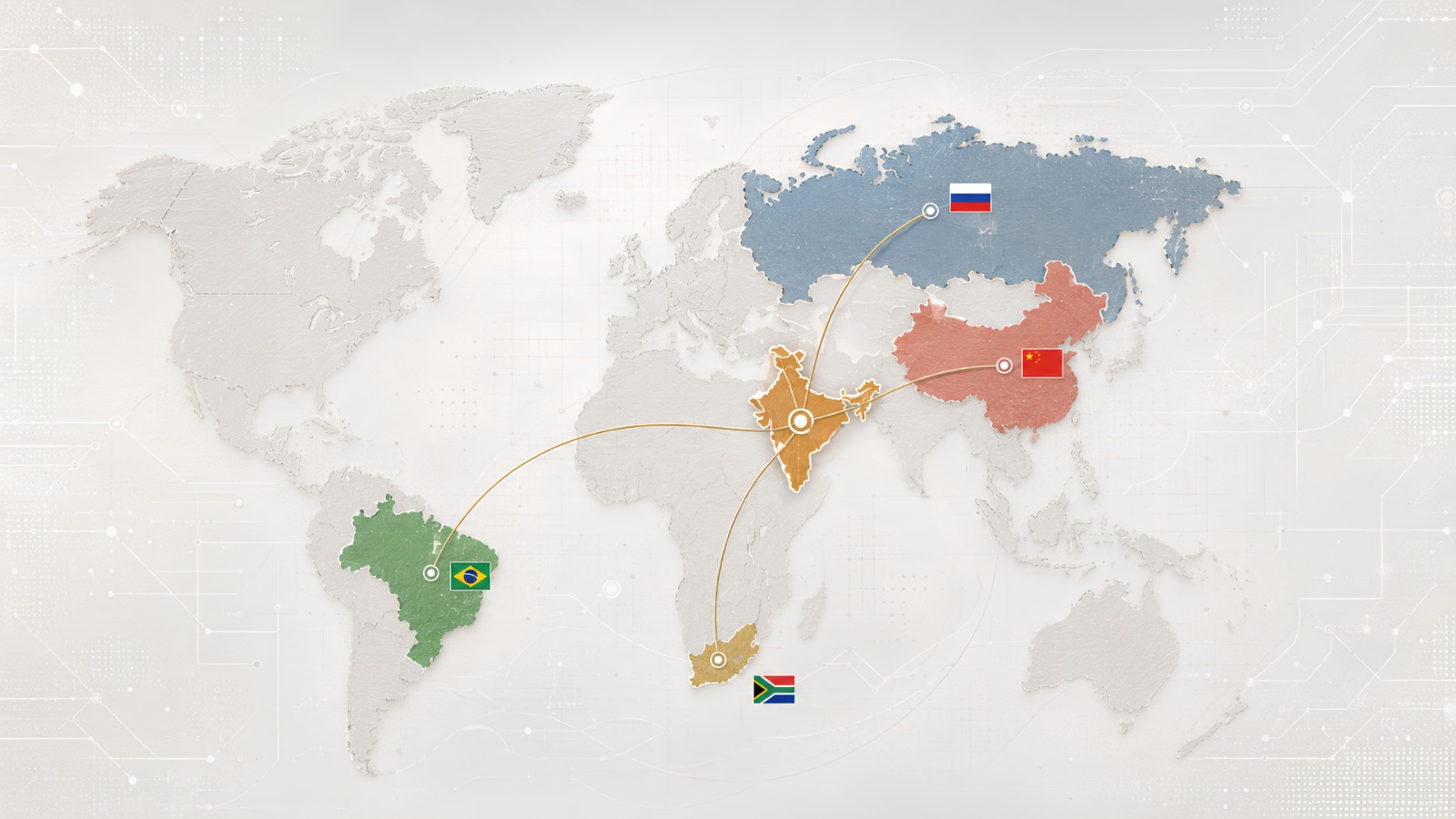
Rooted in the opportunities created by globalization and interregionalism, BRICS can be understood as the growing influence of emerging powers in the international system. The acronym BRICS refers to Brazil, Russia, India, China and South Africa, the latter joining the grouping in 2010 upon invitation from the original BRIC members. Since its inception, BRICS has sought to promote a framework of international cooperation that differs from the traditional Western led order by emphasizing transregional cooperation, and multipolarity, and the interests of developing countries, Consequently, BRICS has been widely recognized for strengthening South-South cooperation and advancing alternative forms of regional engagement.
India’s BRICS Chairship
India’s 2026 BRICS Chairship can be understood as a continuation of the agenda set by Brazil in 2025, “Strengthening Global South Cooperation for more Inclusive and Sustainable Governance” which consolidated BRICS as a platform for widening cooperation across development-oriented areas such as global health, climate governance, trade and investment, and reform of global institutions. India’s subsequent chairship builds on this foundation as it moves the agenda from broad priorities to the practical implementation of cooperation under the theme “Building for Resilience, Innovation, Cooperation and Sustainability”.
Rather than concentrating on internal consolidation or institutional reform alone, India expands the focus toward addressing structural global challenges such as economic volatility, technological disruption, climate change, and supply-chain fragility. This evolution could also be the result of the weaponization of trade tariffs witnessed by many countries, conflict in west asia, and structural realignment of strategic interests as well as global oil markets.
The Ministers’ statement underscores BRICS’ commitment to safeguarding a fair and rules-based international economic system that accommodates the diverse developmental realities of its members, alongside their shared concerns regarding unilateral protectionist measures that undermine multilateral trade norms, reflects the grouping’s commitment to fostering an equitable and predictable international economic environment. This was followed by condemnation of unilateral coercive measures and sanctions imposed outside the framework of the United Nations. In connecting sanctions with broader socioeconomic and environmental challenges, BRICS believes that development opportunities should not be constrained by external economic pressures.
BRICS and AI
Another important issue that emerged as a continuation of discussions initiated under Brazil’s presidency was Artificial Intelligence (AI). Often described as the “New frontier of global governance,” AI occupied a prominent place in the Leaders’ Declaration on the Global Governance of Artificial Intelligence adopted during the 17th BRICS Summit in Brazil. The declaration raises an important question: why does BRICS seek to carve out its own role in shaping the future of AI governance?
For decades, the architecture of the international order has largely rested on institutions such as the United Nations, the World Trade Organization, the World Bank, and the International Monetary Fund. Yet, as global power dynamics continue to shift, new platforms have begun to emerge, offering alternative avenues for cooperation and norm-setting. In this evolving landscape, BRICS has sought to move from being merely a forum for dialogue to becoming a “seat at the table” in determining the rules that govern emerging technologies. As a group that attempts to champion the interests of the Global South, BRICS views participation in AI governance not as a choice but as a necessity.
During the 17th BRICS Summit, Brazilian President Luiz Inácio Lula da Silva reaffirmed the need for equitable governance of artificial intelligence, asserting that the technology should not be confined to the interests of a privileged minority or exploited as an instrument of manipulation by economically powerful actors. Instead, governance frameworks must reflect diverse developmental realities and ensure that no country is left behind in the ongoing digital transformation.
While building a collaborative framework for AI governance is easier said than done, BRICS maintains that it remains achievable through inclusive international cooperation and multi-stakeholder engagement. The declaration emphasizes that stakeholders from both developed and developing countries should bring their unique expertise, perspectives, and resources to the table. This principle lies at the heart of the BRICS vision of AI governance, one that seeks to bridge rather than widen existing technological divides. The ministers further acknowledged that AI presents immense opportunities to stimulate economic growth, innovation, and sustainable development.
Challenges Ahead
Initially hailed as a potential alternative to the Western-dominated international order, BRICS has sought to reflect the realities of an increasingly multipolar world. However, the grouping faces several internal and external challenges that constrain its effectiveness. Although BRICS cooperation is structured around three broad pillars, economic, security and society cooperation, and people-to-people exchanges its primary focus remains on economic development and financial cooperation. Its influence on international security issues remains relatively limited, owing to divergent strategic interests among its members, varying security priorities, and a general reluctance to employ military power as an instrument of collective action.
While BRICS presents its AI governance agenda as an effort to democratize global digital governance and amplify the voices of developing countries, these initiatives are also driven by domestic economic and strategic considerations.
For countries such as India and China, leadership in AI governance offers an opportunity to influence the emerging rules, standards, and regulatory frameworks as AI increasingly becomes a source of economic competitiveness, technological sovereignty, and geopolitical influence. In this sense, the pursuit of a more inclusive AI governance framework is intertwined with broader ambitions to secure technological leadership and reduce dependence on Western-dominated digital ecosystems.
As the international system continues to experience heightened geopolitical tensions, economic fragmentation, and the straining of several key bilateral relationships, the effectiveness of multilateral platforms such as BRICS is increasingly being put to the test. Against this backdrop, the September 2026 BRICS Summit assumes particular significance. Given the considerable developments that have unfolded between the 2025 and 2026 summits, it will be instructive to observe how BRICS navigates an increasingly uncertain international environment.
Conclusion
While it is relatively easy to aim for the moon in summit declarations and outcome documents, the real measure of BRICS’ effectiveness lies in its ability to translate ambitious rhetoric into tangible outcomes. This challenge becomes particularly significant as India assumes the chairship. India’s leadership will be judged not only by the breadth of the agenda it sets but also by its ability to build consensus among an increasingly diverse and expanded membership.
The challenge before BRICS is not merely to remain relevant but to demonstrate its capacity to translate aspirations into cooperation. In many respects, the summit will reveal whether the grouping can successfully steer its course through a time marked by strategic competition, economic volatility, and competing visions of global order. As noted in the Chair’s Statement, “BRICS is fundamental to contributing to the global effort towards a sustainable future and equitable and just transitions for all.” The extent to which BRICS can transform this ambition into concrete outcomes will ultimately determine its credibility as a leading platform for cooperation among emerging and developing economies.