

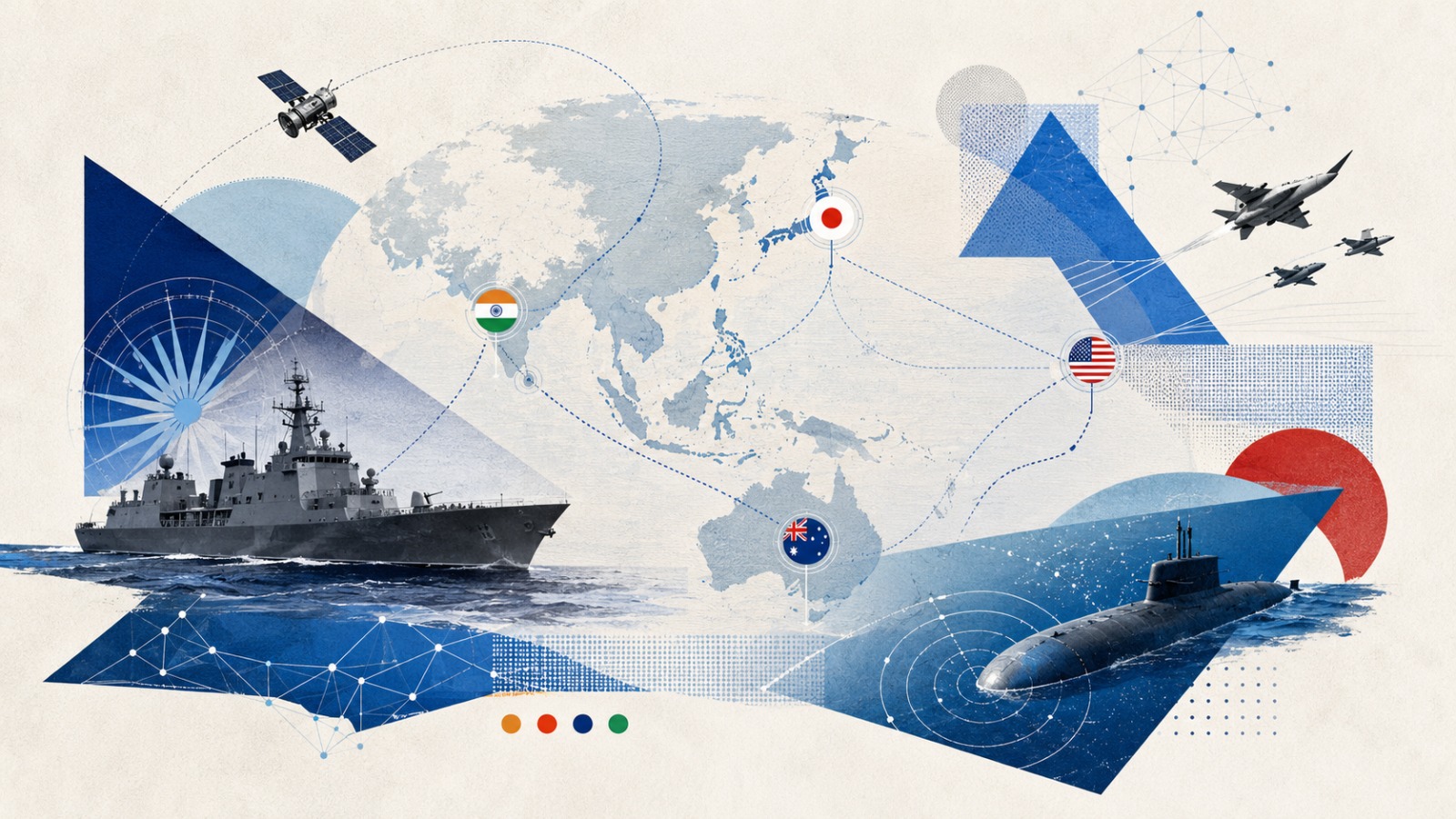
The growing strategic importance of the Indo-Pacific in security, energy, and connectivity has driven greater international engagement in the region. In this context, the Quadrilateral Security Dialogue (QUAD) has emerged as a key platform bringing together India, Australia, Japan, and the United States. Beyond traditional security cooperation, QUAD reflects a convergence of interests aimed at promoting regional development, connectivity, resilience, and a free, open, and inclusive Indo-Pacific.
The evolution of the QUAD reflects a shift from a narrow conception of security towards a more comprehensive understanding of regional order in the Indo-Pacific. Its origin can be traced to the coordinated humanitarian response mounted by the four countries following the 2004 Indian Ocean tsunami. Building on this cooperation, Japanese Prime Minister Shinzo Abe sought to institutionalize the four-nation partnership through a Quadrilateral Security Dialogue, guided by his vision of the ‘Confluence of the Two Seas’ and the need to enhance maritime security and strategic coordination among the region’s leading democracies in the face of China’s growing influence. While the QUAD was initially viewed through the prism of traditional security and maritime cooperation, its revival in 2017 marked a transition towards a multidimensional agenda.
Since then, the grouping has progressed to encompass a range of non-traditional and transnational challenges, including climate change, infrastructure development, humanitarian assistance, disaster relief, AI and health security. This evolution reflects the growing recognition that contemporary security challenges are transnational, interconnected, and cannot be addressed through military instruments alone.
Next Frontier of QUAD Cooperation
The QUAD Foreign Ministers Meeting held in New Delhi on 26 May 2026 marked an important development in the grouping’s efforts to translate strategic dialogue into practical cooperation. The meeting brought together Australian Foreign Minister Penny Wong, Japanese Foreign Minister Toshimitsu Motegi, and U.S. Secretary of State Marco Rubio to discuss emerging security and economic challenges in the Indo-Pacific and beyond.
There is hardly any multilateral dialogue today that does not address the elephant in the room: Artificial Intelligence (AI). The QUAD is no exception. While AI is likely to become the defining technology of the QUAD’s next phase of cooperation, the grouping is also placing increasing emphasis on undersea cable resilience, critical and emerging technologies, and pharmaceutical supply chains.
Recent conflicts in West Asia have demonstrated that unprotected and poorly diversified supply chains can become strategic vulnerabilities, capable of bringing national economies to a standstill. In this context, the QUAD’s emphasis on AI which is transforming economic productivity, defence planning, healthcare delivery, supply-chain management, and scientific research at an unprecedented pace reflects an effort to build resilience against potential acts of aggression in the Indo-Pacific region.
Considering the frequently discussed possibility of heightened tensions across the Taiwan Strait by 2027, the QUAD, while avoiding an explicit position on the issue, remains attentive to the regional security implications. Its efforts to strengthen maritime cooperation and interoperability among member states are intended to enhance regional stability and deterrence.
The QUAD’s commitment to secure digital ecosystems and trusted networks reflects the understanding that progress in artificial intelligence depends not only on algorithms but also on access to semiconductors, computing capacity, data infrastructure, and critical minerals. Taken together, its focus on AI, emerging technologies, supply-chain resilience, and energy security signals an evolving recognition that strategic competition in the Indo-Pacific will be shaped not only by military strength but also by control over the infrastructure and technology that underpin economic growth and national power.
Beyond digital infrastructure and energy security, the foundation of technological power ultimately rests on access to critical minerals, the hidden backbone of the modern economy. It is in this context that the QUAD Critical Minerals Initiative, launched during the July 2025 Foreign Ministers’ Meeting, represents a significant strategic development. By aligning the complementary strengths of the United States, India, Australia, and Japan across extraction, processing, recycling, and stockpiling, the initiative seeks to reduce concentrated dependencies and build more resilient supply networks supported by private investment and industrial coordination. This approach reinforces the broader concept of Pax Silica, as U.S. Under Secretary of State Jacob Helberg observed, “If the 20th century ran on oil and steel, the 21st century is going to run on computers and minerals.”
Evidently, the road ahead is far from smooth. Significant challenges remain, as building alternative supply chains to reduce dependence on China will require substantial investment, long time horizons, and extensive coordination between governments and private industry. For many Indo-Pacific countries, balancing interaction with QUAD while maintaining economic relations with China will continue to pose a delicate policy dilemma. For the QUAD, success will depend not only on securing critical resources but also on developing an innovation ecosystem capable of supporting next-generation technologies, particularly artificial intelligence.
In response to the recent QUAD meeting held in New Delhi, China’s official spokesperson Mao Ning said China is against forming exclusive groupings. China views the QUAD partnership as an effort to curb its influence in the region, labelling it as ‘cold war thinking’. From Beijing’s perspective, the QUAD is less significant as a formal alliance and more consequential as a potential nucleus of broader alignment-building among advanced economies and regional partners. Ultimately, the QUAD’s longer-term significance depends on whether it develops into a sufficiently cohesive framework capable of balancing China’s influence in Asia and beyond.
Conclusion
In sum, the QUAD’s expanding cooperation in critical minerals, artificial intelligence, and energy security signals a clear attempt to strengthen economic resilience, diversify supply chains, and reinforce stability across the Indo-Pacific. These initiatives also reflect mounting concerns over China’s entrenched position in critical mineral processing and its widening economic footprint across the region.
However, the jury is still out on the QUAD’s long-term effectiveness. Questions remain regarding institutional coherence and the ability to align diverse strategic priorities within a sustained framework. This evolution across multiple domains including artificial intelligence, climate action, infrastructure, humanitarian assistance, disaster relief, and health security, alongside traditional security concerns reflects a broad but interconnected agenda. It also reflects the recognition that contemporary challenges are transnational in nature and cannot be addressed through military instruments alone. In this sense, the QUAD continues to walk a fine line, functioning simultaneously as a platform for practical cooperation, strategic signalling, and norm-setting within an increasingly contested Indo-Pacific environment.